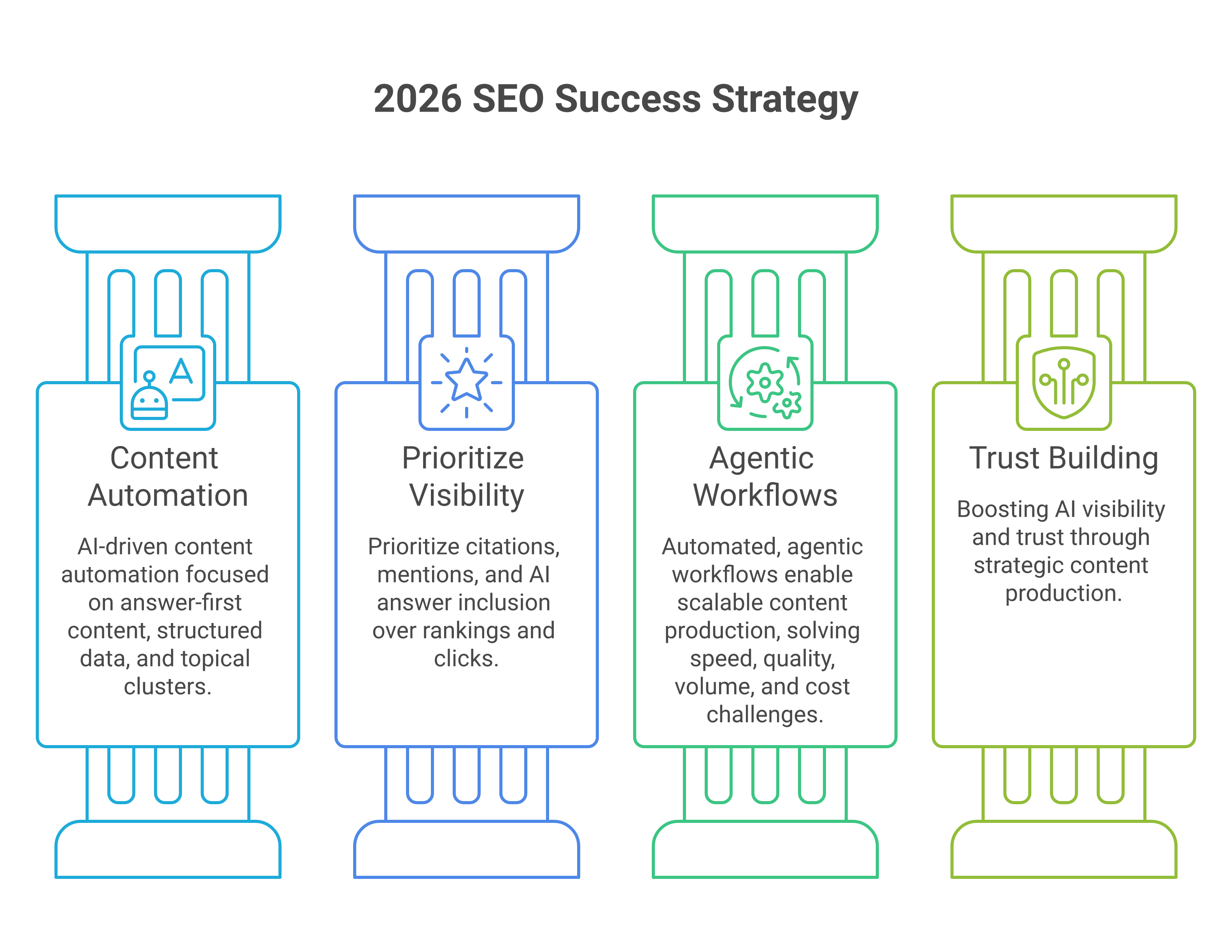

Announcement: A decisive shift is happening in how answers find audiences, and it changes what SEO experts must optimize for now.
Generative answer engines and large language models are not a future threat, they are the present. Content that is structured, cited, fresh, and demonstrably expert is the content that LLMs will use and cite, and that matters for visibility, trust, and conversions. This article explains what LLM rankings are, why they matter for SEO experts, and which content solutions move the needle fast for small marketing teams with limited bandwidth.
- Will your brand be a source that assistants choose to cite, or will it fade into the training corpus?
- Will your next campaign prioritize original data, or more keyword-driven repetition?
- Will your team invest in schema, citations, and author credibility this quarter?
Table of contents
- What LLM rankings mean right now
- How LLMs find and choose web content
- Why LLM rankings matter for SEO experts
- Core content solutions to improve LLM rankings
- A numbered list of practical tactics you can apply this week
- Implementation roadmap for small marketing teams
- Short term, medium term and longer term implications
- Key takeaways
- Faq
- About Upfront-ai
- Final CTA
What LLM rankings mean right now
LLM rankings describe how likely a generative model or answer engine is to surface, reference, or cite a specific piece of content when producing an answer. This differs from classic search engine ranking because the output is often a synthesized answer rather than a ranked list of links. Content that is easily retrievable, authoritative, and machine-readable has a higher chance of being used as grounding or a cited source in these outputs. When a brand secures a place in the answers that users read first, it controls the narrative, builds trust, and captures downstream conversions.
How LLMs find and choose web content
LLMs typically mix internal knowledge with retrieval systems, so they use recently indexed web content as evidence. This hybrid approach, often called retrieval-augmented generation, favors pages that are crawlable, structured, and cited. Signals that matter include structured data (schema), clear author credentials, original datasets, in-text citations, and freshness. Entities and consistent naming make it easier for knowledge graphs or retrieval layers to connect your content to a recognized brand or topic.
Why LLM rankings matter for SEO experts
LLM-driven answers are reducing click-throughs from traditional SERPs and redirecting user attention to synthesized replies. If your brand is absent from those replies, you lose influence at the moment of decision. Being cited in an assistant answer functions like a modern endorsement, increasing brand recall and often driving branded searches and direct visits later. This is not hypothetical, it is strategic evolution: future search journeys are answer-first, and SEO experts must adapt their playbooks.
Core content solutions to improve LLM rankings
People-first content
Write answers that human readers want and that machines can understand. Prioritize clarity, examples, step-by-step guidance, and practical next steps. This reduces bounce, increases dwell time, and makes content more likely to be used as evidence in model outputs.

E-E-A-T, with emphasis on experience
Document first-hand results, case studies, benchmarks, and author experience. LLMs and answer engines prefer cited, verifiable sources. Include author bios, credentials, and context for claims so the retrieval layer can ground assertions to identifiable experts.
Structured data and machine-readable signals
Implement article, FAQ, dataset, and author schema to make content easier to index and retrieve. FAQ and QAPage schema in particular increase the odds of being used as a direct answer. Tools and audits that check schema implementation are now basic hygiene for LLM visibility.
Citations and link signals
Quality backlinks remain important, but explicit in-text citations help generative systems attribute facts. Link to primary sources and datasets. When your content is the best available source on a topic, assistants will treat it as evidence.
Original research and proprietary data
Publish benchmarks, surveys, instrumented results and downloadable datasets. Original data is highly citable, and it creates durable authority across answers and summaries.
Topical clustering and entity optimization
Build pillar pages and clusters that show coherent topical depth. Consistent entity names, internal linking, and author attribution strengthen your brand as a mapped node in retrieval layers.
Freshness and cadence
For time-sensitive queries, freshness matters. Schedule updates for top-performing pages and publish frequent insights. Automation can help maintain a cadence of new, high-quality outputs.
Technical SEO and accessibility
Ensure pages serve plain HTML text, not only client-side rendered content, and meet speed and accessibility standards. Retrieval systems rely on indexed text and clean markup.
A numbered list of practical tactics you can apply this week
Overview: This list pares tactics down to the essentials so small teams walk away with practical steps they can implement immediately. The goal is to create content that LLMs prefer, while keeping the workload manageable.
- Run an LLM-focused audit, identify which pages are already referenced in AI answers and which queries bring synthetic outputs. For guidance on audit steps and conversational formatting, see the Wellows LLM SEO primer .
- Publish one piece of original data, such as a small survey or an anonymized benchmark, and attach a downloadable CSV and dataset schema. This single asset often produces multiple citations and backlinks over time.
- Add FAQ schema to three high-traffic pages to expose structured Q&A snippets that increase selection odds.
- Add author bios with credentials to every substantive article so retrieval layers can attribute experience and expertise.
- Build five high-quality citations by reaching out to two industry newsletters, one partner site, and two niche blogs for mentions or guest posts. Quality beats quantity for model grounding.
- Refresh one evergreen pillar page by updating data, adding citations, and including structured dataset references; republish and note dateModified in schema.
- Expose machine-readable tables and CSVs so retrieval layers can parse and cite your data.
- Ensure crawlability and canonicalization by confirming key pages return server-rendered HTML, have correct canonical tags, and are present in sitemaps.
- Measure generative mentions and track branded citations; for monitoring approaches and best practices, review the Troo Inbound guide on LLM SEO .
Recap: These nine tactics are designed to be sequential and compounding. Start with an audit, publish unique evidence, add schema and authorship, and finally focus on outreach. Use the list as a 30 to 90 day checklist to allocate scarce resources for maximal generative impact.
Implementation roadmap for small marketing teams
Step 1, audit and brand model: Create a one-company model that captures voice, tone, core topics, and proof points. This is the central knowledge source for every content piece and helps maintain consistent entity signals.
Step 2, prioritize topics: Map topics to buyer intent and pick three pillars to focus on for the quarter. Prioritize those that benefit directly from original data.
Step 3, create with editorial controls: Use AI-assisted drafting to scale ideation and first drafts, but keep humans in the loop for factual validation and tone. A hybrid workflow produces consistent, high-quality outputs faster.

Step 4, on-page optimization: Add metadata, structured schema, author bios, and in-text citations. Ensure machine-readable assets and accessible transcripts for multimedia.
Step 5, distribute and earn citations: Combine outreach, syndication, and partner placement to secure authoritative mentions and backlinks.
Step 6, measure, iterate and scale: Track generative visibility, citations, SERP features, organic impressions, and conversions. Iterate on formats that produce the most evidence-based citations.
Short term, medium term and longer term implications
Short term: Expect quick wins by publishing original, citable assets and adding FAQ schema. Within 30 to 45 days, a focused program can increase exposure, especially for niche queries. Internal platform testing often shows exposure improvements when brand models, schema, and outreach are combined.
Medium term: Over 3 to 6 months, consistent publication of data and continued link-building produce more durable authority. Knowledge panels, featured snippets, and branded mentions increase, and those signals attract more organic and branded traffic.
Longer term: In 6 to 18 months, brands that prioritize first-hand research, structured metadata, and persistent author credibility become primary sources for answer engines. This yields sustained citation frequency, improved conversions, and a stronger moat against commoditized content.
How automation and platforms change the calculus
Automation lets small teams execute at scale, but only when it preserves experience and human verification. A platform that stores a single brand model, enforces editorial standards, and automates schema can sustain a high publishing velocity while keeping content credible and citation-ready. Numbers matter, both for cadence and for proof. For example, frameworks that combine hundreds of storytelling techniques and replicated title formats help content teams produce consistent, high-quality outputs quickly. These elements combine to make content both human-pleasing and machine-friendly.
Common pitfalls to avoid
- Over-optimizing for keywords without adding original evidence.
- Publishing thin content that lacks author reputation or first-hand experience.
- Ignoring structured data or implementing it incorrectly.
- Relying solely on AI drafts without human fact checking.
- Treating LLM optimization as a one-time project instead of an ongoing program.
Key takeaways
- Prioritize original data, author credibility, and schema to increase the chance LLMs will cite your content.
- Run an LLM-focused audit, add FAQ schema, and publish at least one dataset in the next 30 days to create traction.
- Track generative mentions, backlinks, and SERP features, and iterate on formats that produce measurable citations.
- Use automation only when it preserves experience and human oversight, so every claim can be traced to a credible source.
Faq
Q: what is an llm ranking and how does it differ from traditional seo ranking?
A: an llm ranking is the likelihood that a generative model or answer engine will use or cite your content when producing an answer, while traditional seo ranking measures placement in search engine result pages. llm rankings favor machine-readable structure, explicit citations, author credibility, and original data. both require relevance and authority, but llm optimization places additional emphasis on schemas, datasets, and clear provenance. to win both, combine people-first content with machine-friendly signals.
Q: how quickly can a business see improvements in llm visibility?
A: small wins can appear within 30 to 45 days after publishing original, citable assets and implementing schema, while more durable authority takes 3 to 6 months of consistent work. measure short-term exposure lifts, then track medium-term increases in citations and organic traffic. remember that outreach and backlinks are often the multiplier that turns content into a cited source.
Q: what content formats do answer engines prefer?
A: answer engines prefer content that is factual, structured, and verifiable. datasets, tables, downloadable csvs, faq pages, and detailed how-to guides are highly favored. multimedia helps when accompanied by full transcripts and structured metadata. original research and case studies are particularly valuable because they provide unique evidence that assistants can cite.
Q: how does e-e-a-t improve the chance of being cited by llms?
A: e-e-a-t improves traceability and trust. experience and expertise make your content demonstrably authoritative, while authoritativeness and trustworthiness provide the context for long-term citations. include author bios, methodology sections, and transparent sourcing so retrieval systems and human raters see your content as credible. this increases the chance llms will select your content as evidence.
Q: what metrics should teams track to measure llm ranking success?
A: track generative mentions where detectable, the number of authoritative citations and backlinks, serps feature presence, organic impressions and ctr, and page-level conversions. create an experimentation cadence to compare e-e-a-t enhanced pages against control pages to measure the causal impact of your investments.
About Upfront-ai
Upfront-ai is a cutting-edge technology company dedicated to transforming how businesses leverage artificial intelligence for content marketing and SEO. By combining advanced AI tools with expert insights, Upfront-ai empowers marketers to create smarter, more effective strategies that drive engagement and growth. Their innovative solutions help you stay ahead in a competitive landscape by optimizing content for the future of search.
You have the tools and the knowledge now. The question is: will you adapt your SEO strategy to meet your audience’s evolving expectations? How will you balance local relevance with clear, concise answers? What is the first GEO or AEO tactic you will implement this week? The future of SEO is answer engines, make sure you are ready to be the answer.