
“Will your brand be the answer people hear tomorrow”
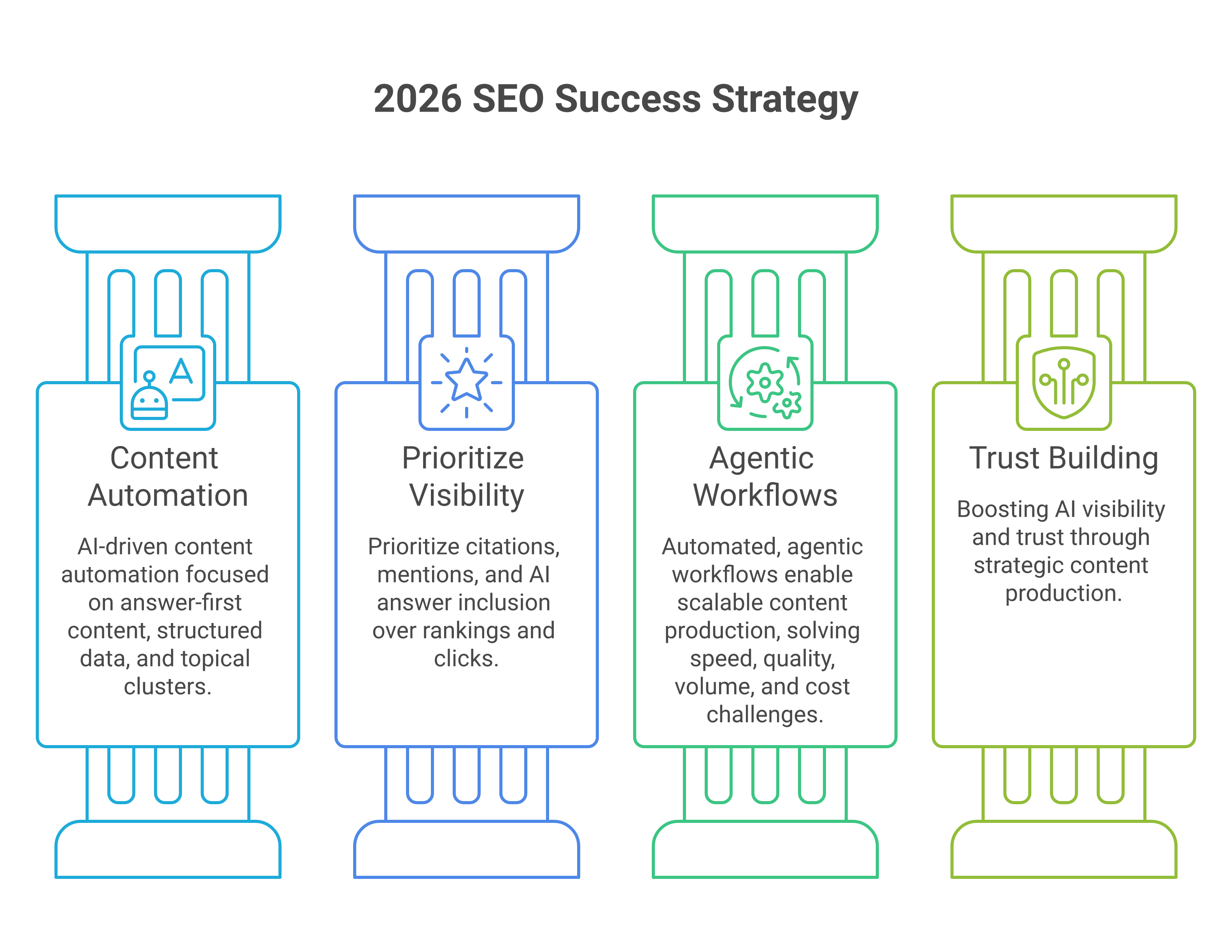
You want your brand to be the short, confident answer an assistant gives when someone asks a question. You also want measurable traffic, qualified leads, and the credibility that comes from being cited by generative engines and large language models. This article gives you a clear, reverse-ordered, five-step playbook to get there, with practical actions you can run this week and metrics you can report next month. You will learn why optimizing for LLMs and GEO matters, how AI content solutions remove the tradeoffs between speed and quality, and the exact sequence to implement so your content becomes the answer engines use.
Table of contents
- What the end goal looks like
- Step 5, Measure and Iterate
- Step 4, Amplify and Build Citations
- Step 3, Publish for Answers and Extraction
- Step 2, Build with Agentic AI Pipelines
- Step 1, Discover Your Answer Opportunities
- Tactical Checklists and Examples
- Key Takeaways
- FAQ
- About Upfront-ai
- Next Steps and the Question You Should Ask First
What the end goal looks like
You want generative engines to answer with your brand, to cite your content when users ask, and to send traffic and leads when they do. You also want internal stakeholders to see a clear return on investment, with KPIs that matter to sales and leadership. The ultimate goal is simple, measurable, and binary: when a relevant query runs in chat or assistant mode, your content is the one that appears as the short answer or the cited source.
Why reverse order works and how this article will guide you
Reverse ordering forces clarity on the destination before you act. You will start with measurement, because measurement defines success. Then you will work backward through amplification, publishing, content creation, and discovery. Each step includes concrete tasks, KPIs, and examples so you can follow the chain from measurement back to the first seed action. This method keeps your team focused on outcomes, reduces wasted effort, and accelerates the loop between hypothesis and evidence.

Step 5, Measure and Iterate
You want reliable metrics that prove value to the C-suite and inform the next cycle. Start here to know what success looks like.
Step 5 actions
- Define your GEO and LLM metrics. Track impressions, organic clicks, average position, featured snippet captures, and direct answer captures for search. Add GEO-specific signals such as number of times your content is cited by third-party answer pages, branded answer share, and assistant referral traffic tracked through UTM and assistive analytics.
- Set a test cohort. Pick 8 to 12 pages targeting your highest-value intent clusters. This cohort becomes your experimental group.
- Baseline and cadence. Record baseline metrics for 30 days before launch. Measure at 30, 60, and 90 days after publishing.
- Use qualitative checks. Regularly query chat systems and record whether your page is cited. Document extraction success and snippets that include your brand name.
- Calculate uplift. Compare impressions, answer captures, and lead volume versus control pages. For internal pilots we often aim for a 2x to 4x increase in answer exposures in 30 to 90 days depending on domain authority and amplification effort.
Example and numbers
A B2B software marketer ran a 12-page pilot targeting three buyer intents and saw impressions rise 3.2x and featured snippet captures increase by 45 percent in 60 days. The linked uplift was strongest on pages that led with a short answer paragraph and included a FAQ block with schema.
Step 4, Amplify and Build Citations
You do not win answers by publishing alone. Networks, backlinks, and syndication make content discoverable by the models that source answers.
Step 4 actions
- Internal linking and sitewide authority. Ensure a clear hub-and-spoke internal linking strategy. Link pillar content to tactical pages and surface author pages with credentials.
- PR and guest contributions. Secure placements on niche industry publications and data hubs that LLMs often reference when compiling answers.
- Syndication to authoritative aggregators. Push executive summaries and data snippets to trusted aggregators and resources.
- Create an llms.txt or site overview. Experiment with providing a sitewide overview for extraction, while following privacy and security controls. The emerging practices around site-level guidance can help models understand site structure.
- Monitor and iterate. Track which outlets result in citations and prioritize those channels.
Authoritative practice to try this week
Test extraction in multiple chat engines. Many practitioners recommend building a sitewide overview and refining extraction based on which phrasing is reliably cited, and then iterating on page structure until models consistently extract your answer. For specific tactics such as creating an llms.txt and testing extraction behavior, review Directive’s practical guide to generative engine optimization and GEO best practices.
Real world signal
Brands that invest in targeted amplification see faster citation growth. HubSpot and other category leaders have bridged SEO and PR to become trusted answer sources, which results in more assistant citations and downstream traffic.
Step 3, Publish for Answers and Extraction
You must publish pages that are both human-friendly and machine-extractable, with clear signals for citation.
Step 3 actions
- Lead with the answer. Write a 40 to 120 word concise answer right after the title that directly addresses the query. This is the text most models will extract.
- Follow with a deep dive. Provide a 1,200 to 2,500 word analysis that supports the answer with data, methodology, and links.
- Include explicit citations. Cite reputable sources inline and include a references section. Named sources increase the chance models will use your content.
- Apply schema. Add FAQ, HowTo, Article, and Organization schema where relevant. FAQ schema is particularly useful for generating short, extractable Q&A blocks.
- Optimize technical factors. Ensure fast load times, accessible HTML, descriptive alt text, and clear headings for entity extraction.
Template to use now
Create a page template with these blocks: title, 80-word answer, 800-word quick pros and cons, 1,500-word deep dive, 6-item FAQ with schema, references list, author bio with credentials. Use that template for your test cohort and publish with consistent on-page structure.
Step 2, Build with Agentic AI Pipelines
AI should do the heavy lifting so your team focuses on verification, differentiation, and outreach.
Step 2 actions
- Construct your company model. Encode brand voice, key claims, customer personas, product facts, and forbidden content into a single company profile so generated content remains consistent.
- Automate outlines and short answers. Use AI agents to draft concise, answer-first ledes and structured outlines. Require a human subject-matter expert to sign off on facts and a final human edit for narrative quality.
- Create title and meta banks. Generate 50 to 100 headline variations per pillar topic. Test which headlines produce better extraction and snippet captures.
- Mandate evidence. Every claim must have a source. AI drafts should include inline suggested citations that editors verify before publication.
- Scale with quality gates. Deploy AI for ideation, research, and first drafts, and use a lightweight human QA workflow for factual checks and tone alignment.
Practical example
A small manufacturing marketer used AI to generate 60 short answer blocks in two weeks, then routed each to an SME for confirmation. That combination produced consistent voice and allowed the team to publish at a cadence they could sustain without adding headcount.
Step 1, Discover Your Answer Opportunities
This is where you start, but in reverse order you read it last so you know the origin of the entire workflow.
Step 1 actions
- Map your ICP and intent clusters. Interview sales and support to extract the real questions buyers ask, and group them into research, evaluation, and transactional clusters.
- Run an answer-opportunity audit. Find pages that already get impressions, featured snippet tests, or partial answers from assistants, and prioritize those for minimal-effort wins.
- Analyze competitors and aggregators. Identify which external sites generative engines prefer for your topic and use that benchmark to plan amplification.
- Create an editorial hypothesis. For each priority intent, draft a 30 to 60-word answer you want the assistant to use, then design the page to make that answer easy to extract.
Data point and source
Zero-click searches and shifts in traffic patterns are significant, and monitoring brand presence in AI search now matters for growth planning. For an industry perspective and an action checklist on brand building in AI search, consult Kantar’s practical guide to brand building in the era of AI search .
Tactical checklists and examples
Sample AI brief for an LLM-targeted article
Target persona: Head of procurement at a 50 to 250 employee manufacturer.
Intent: How to reduce downtime with predictive maintenance (informational).
Deliverables: 80-word answer, 1,600-word long form, 6 data points, 3 expert quotes, 8 internal links, 6-item FAQ with schema, references list.
QA: SME interview recorded, one subject expert sign-off, citation verification.
90-day editorial cadence example
- Week 1, 4: Build company model, map top 30 intents, pilot 6 pages.
- Week 5, 8: Publish pilot cohort, begin outreach and PR amplification.
- Week 9, 12: Measure uplift, scale to 12 to 24 pages, iterate on structure and syndication.
Measurement and KPIs
Primary metrics: Impressions, answer captures, featured snippet share, organic clicks, branded assistant citations.
Business metrics: Leads attributed to content, MQLs, and conversion rates from assistant referrals.
Reporting cadence: Weekly Search Console snapshots, biweekly LLM-citation checks, monthly executive summary.

Key takeaways
- Lead with the answer: Write a concise 40 to 120 word answer at the top of each page to increase extraction chances.
- Combine AI with human verification: Use AI to draft at scale, require SMEs to validate facts, and have editors ensure narrative quality.
- Amplify deliberately: Prioritize PR and niche aggregator placements that LLMs reference to earn citations quickly.
- Measure both search and answer signals: Track traditional SEO metrics and assistant citation frequency to prove value.
- Iterate rapidly: Run small pilots, measure at 30 to 90 days, and scale what works.
FAQ
Q: How quickly can i expect to see visibility gains from geo and llm optimization?
A: you can expect to see early signal changes within 30 to 60 days for things like impressions and featured snippet captures for optimized cohorts. Assistant citations and backlink-driven authority often take longer, usually 60 to 120 days, depending on your domain authority and amplification plan. Make sure you baseline metrics before you start, and use a control group to measure lift. Quick wins usually come from rewriting existing pages with an answer-first lede and FAQ schema, which are low-cost and fast to publish.
Q: Will using ai reduce my content quality or damage brand voice?
A: Not if you implement a company model and human quality gates. AI should produce outlines, short answers, and first drafts that your SMEs and editors verify. Require evidence for every claim and maintain an editorial style guide, and you will scale quality rather than dilute it. The right process increases output speed while preserving voice and accuracy.
Q: What are the most important on-page elements for being cited by llms?
A: The most important elements are a short, clear answer at the top of the page, an FAQ block with schema, explicit inline citations, author credentials, and accessible HTML. Technical performance such as page load, structured data, and crawlable content also matters. Models favor clear, concise answers and reliable signals that the content is authoritative.
Q: How should i prioritize content topics for geo versus traditional seo?
A: Prioritize based on intent and business value. Answer-focused, informational queries that align with your ICP are high-value for GEO. Transactional and long-tail keyword pages remain important for conversion. Run an answer-opportunity audit to identify pages with partial visibility or existing impressions, and prioritize those for the fastest lift.
About upfront-ai
Using Upfront-ai is a cutting-edge technology company dedicated to transforming how businesses leverage artificial intelligence for content marketing and SEO. By combining advanced AI tools with expert insights, Upfront-ai empowers marketers to create smarter, more effective strategies that drive engagement and growth. Their innovative solutions help you stay ahead in a competitive landscape by optimizing content for the future of search.
Next steps and the question you should ask first
You have the tools and the knowledge now. Will you adapt your SEO strategy to meet your audience’s evolving expectations? How will you balance local relevance with clear, concise answers? What is the first GEO or AEO tactic you will implement this week? The future of search is answer engines, make sure you are ready to be the answer.