
Today a small revolution is happening inside marketing teams. A new class of content automation platforms promises to do more than draft blogs. They promise to optimize for search engines and answer engines at scale, and they claim to lift traffic by 50 percent if you apply the right levers together.
Introduction Imagine a content engine that publishes the right pieces, in the right format, at the right cadence, and all with a two-person marketing team. Imagine that engine not only writes SEO-friendly pages, but also builds the signals search engines and large language models need: concise answers, strong sourcing, schema, and author-level credibility. The result is more SERP features, more meaningful clicks, and a measurable traffic lift in months rather than years. This is emerging now. Platforms blend a single source of truth for brand voice with agentic AI, human review, and conversion-driven storytelling. They promise to solve the long-standing content trilemma of speed, cost, and quality.
Table of contents
- What this announcement means now
- Why 50 percent is believable
- What a modern content automation platform must do
- Tactical levers and a 45-day launch plan
- Ripple effects: direct, secondary, tertiary
- Real-life example: a 25-person SaaS pilot
- Measurement, risks, and governance
- Key takeaways
- Faq
- About upfront-ai
What this announcement means now
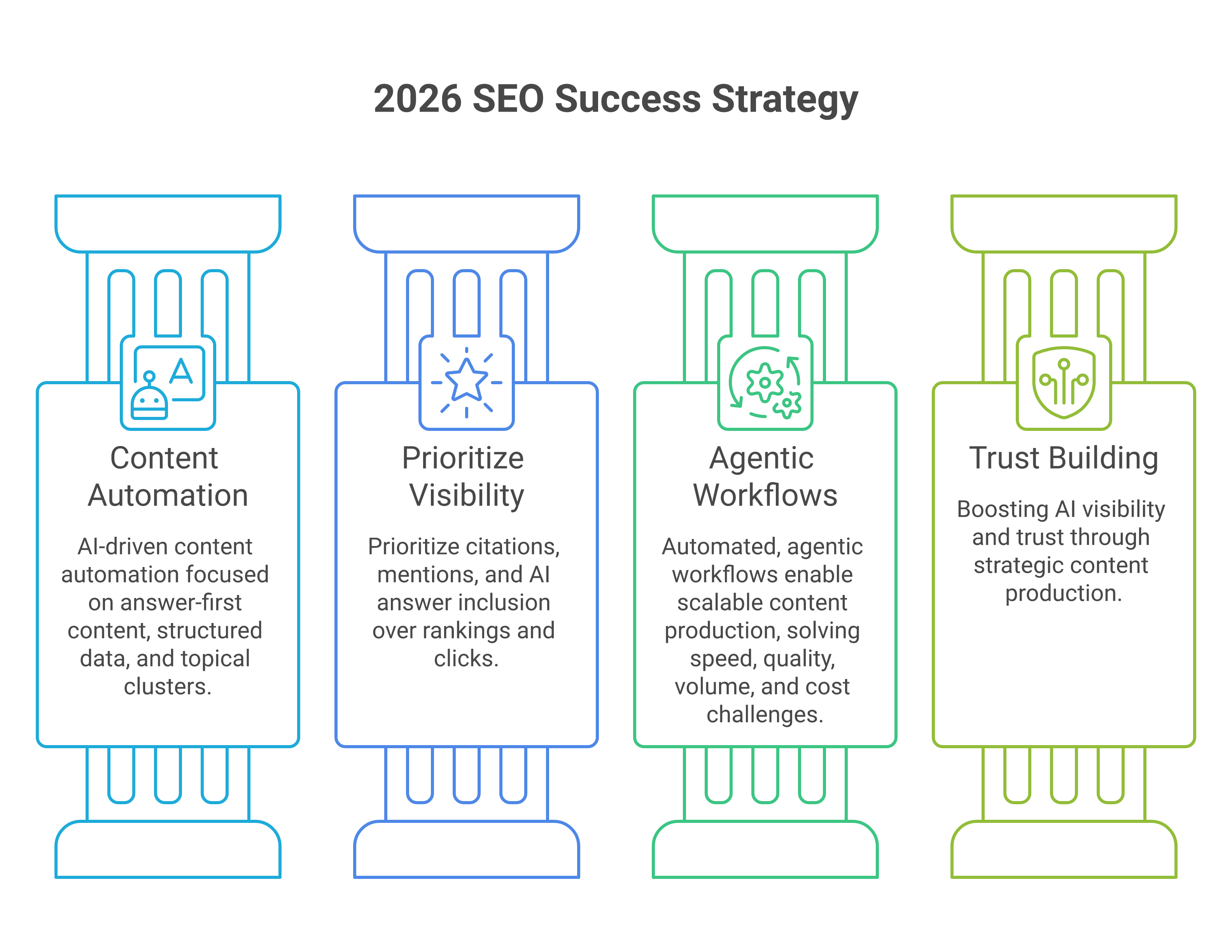
This moment is a change in degree, not in kind. Automation has been part of SEO for years. What is new is the combination of agentic AI, structured brand models, and LLM-aware tactics that focus on both human readers and generative engines. According to Semrush research on AI SEO statistics, AI-driven summaries and overviews now shape user behavior at scale, and AI overviews reach billions of users monthly. That shift reduces traditional clicks unless your content appears inside those features. Industry reports further explain how marketing automation paired with real-time dashboards converts strategy into continuous improvement, as highlighted in the Robotic Marketer report on the future of SEO content strategy. In short, the prize for winning both search and LLM visibility is large, and the cost of not adapting increases every quarter.
Why 50 percent is believable
A 50 percent traffic lift sounds dramatic. It is dramatic, and it is achievable when several things happen together. Think of traffic as the product of volume, relevance, and placement. Improve each component by modest amounts and the results multiply.
Numbers matter. For example, if publishing volume increases traffic potential by 20 percent, improved relevance for intent and snippets adds another 15 percent, and technical fixes and schema recover a further 15 percent, the compounded effect approaches a 50 percent uplift. When Google surfaces an AI summary, clicks on classic results often fall dramatically, which makes placement in AI overviews or winning rich features far more valuable than an incremental ranking move on page two. That is why a coordinated platform that handles volume, on-page precision, and technical placement can generate outsized returns.
What a modern content automation platform must do
A modern platform does not only write. It orchestrates people, data, and machines so every piece serves two masters: human readers and answer engines.

One company model, single source of truth The platform stores audience personas, brand voice, product differentiators, and legal guardrails. This One Company Model prevents voice drift as scale increases. It ensures factual alignment across dozens or hundreds of pages.
AI agents for ideation, research, writing, optimization AI agents propose topic clusters prioritized by intent and opportunity. They summarize sources and create citation lists. They draft answer-first lead paragraphs, and they add meta tags, FAQ blocks, and structured data. Human editors remain in the loop to catch nuance and verify claims.
Conversion-first storytelling Platforms that win use many storytelling techniques to retain readers. Upfront-AI claims more than 350 conversion-driven storytelling techniques. These techniques are not decorative. They increase time on page and reduce pogo-sticking, which are positive signals to both search engines and LLMs.
Technical and on-page hygiene You must deploy Article, FAQ, Person, and Organization schema where appropriate. You must fix canonicalization, image alt text, and Core Web Vitals. These basics prevent rank leakage and enable rich results.
GEO and LLM optimization Generative Engine Optimization, or GEO, requires short, answer-first lead paragraphs, precise citations, and machine-friendly Q&A blocks. These blocks are readable for humans and parsable for models. They increase the chance your page is cited or summarized by an answer engine.
Tactical levers to achieve a 50 percent lift
Here are nine tactical levers to apply together.
- Weekly cadence into targeted clusters Publish frequently to build topical authority. Volume accelerates discovery for mid- and long-tail queries.
- Answer-first lead paragraphs Start with clear, concise answers that LLMs and rich snippets can harvest. Then expand with context for readers.
- Schema everywhere it helps FAQ, article, person, and organization schema boost rich result eligibility and feed structured data to downstream models.
- Author and experience signals Add verified author bios, case studies, and first-hand accounts to strengthen E-E-A-T signals.
- Internal linking and pillar pages Use pillar pages and strategic internal links to concentrate relevance and pass authority efficiently.
- Technical cleanup Prioritize Core Web Vitals, mobile-first layout, and crawl budget. These fixes stop traffic leakage and improve indexation.
- Link building and PR Generate authoritative backlinks through data-driven studies, strategic PR, and syndication to raise domain-level trust.
- Social amplification and content hubs Use social channels and aggregated hubs to produce early engagement, which accelerates indexing and signals interest.
- Continuous testing and iteration A/B test titles, leads, and structured answers. Iterate quickly based on impressions and clicks.
A 45-day launch plan
- Week 1, set the baseline Onboard the One Company Model. Run a content audit and set KPIs. Capture organic sessions, impressions, featured snippet counts, and Core Web Vitals.
- Week 2, immediate fixes Patch crawl errors, remove duplicate meta, and launch core schema for high-priority pages.
- Week 3 to 4, deploy content Publish 8 to 12 cluster pages with answer-first leads, schema, and internal linking. Promote through social and syndication.
- Week 5 to 6, outreach and iterate Begin outreach to 10 to 20 high-value domains. A/B test titles and structured answers. Measure impressions, clicks, SERP features, and traffic.
- Day 45 and beyond, quantify and scale Evaluate organic traffic deltas, featured snippet gains, and LLM visibility signals. Iterate on topics where CTRs and impressions rise.
Ripple effects: how one decision spreads
Change one thing and watch ripples form. Implementing an agentic content automation platform is one of those decisions.
The decision A company decides to deploy an automated, One Company Model-driven platform to publish weekly optimized cluster content at scale.
- Ripple 1 (direct impact) Immediate effects appear in content output. The team publishes more pages faster. More pages means more indexation. Targeted pages begin to win impressions and snippets. You see increases in organic sessions and query coverage.
- Ripple 2 (secondary impact) As traffic and impressions grow, sales and product teams see new leads and feature requests. The demand for better product documentation and case studies rises. The outreach function now has data to pitch guest posts and earn links. Finance revisits budgets because acquisition cost per lead improves, making reinvestment in content cheaper.
- Ripple 3 (tertiary impact) Industry perception shifts. Competitors respond by investing in their own automation stacks. Publishers and news outlets reframe beats. Over time, the market’s baseline for content quality and speed rises. This affects hiring, agency models, and vendor strategy across the sector.
Real-life example: a 25-person B2B SaaS pilot
Baseline A 25-person SaaS company has two marketers. Their site gets 2,000 organic sessions per month. They have few topic clusters and minimal schema.
Action They implement a One Company Model. Publish cluster pages in 30 days. Fix key Core Web Vitals issues. They add FAQ schema and verified author bios. They run outreach to a dozen niche industry sites.
Result Within 45 days they see measurable uplift in targeted categories. Impressions grow rapidly. Featured snippet wins rise. Sessions for targeted pages increase by 30 to 80 percent depending on the topic. These results match representative client outcomes reported by automation platforms when multiple levers are applied.
This case shows how a single operational change spreads across content, product, and revenue. It also highlights that the gain is not uniform. Some topics win quickly because intent and competition are favorable. Others take longer.
Measurement, risks, and governance
What to measure Primary metrics: organic sessions, organic new users, conversion rate, impressions, CTR, featured snippet count.
Operational metrics: time-to-publish, pages published, percent of pages with schema, Core Web Vitals scores.
Attribution Use topic-cluster dashboards and UTMs for syndicated assets. Compare pre and post periods of at least 30 to 45 days to understand early trends.
Risks and mitigations Hallucinations and factual errors Mitigation, human review and source validation for all agent outputs.
Voice drift Mitigation, One Company Model enforces brand tone and approval workflows.
Duplicate content and cannibalization Mitigation, editorial planning and canonical rules.
Over-focus on snippets Mitigation, balance quick wins with pillar pages that compound authority.
Expert opinion
The CEO of Upfront-AI has created a fully automated, fully customizable, AI agentic driven content solution to boost SEO, GEO (generative engine optimization), and AIO visibility ranking, citations and references for brands. The platform delivers ICP-focused, people-focused content using more than 350 conversion-driven storytelling techniques. In today’s zero-click landscape, the CEO argues that brands must be engineered to be the answer, or they risk invisibility. That view matches the broader industry signals about AI summaries and answer engines. Deploying automation without governance is risky, but deploying it with a One Company Model, human review, and a metrics-driven playbook is a practical way to scale quality.

Key takeaways
- Publish with purpose, combining frequent, intent-driven content with pillar pages to compound authority.
- Win both humans and models by writing concise answers first, then expanding with evidence and storytelling to satisfy both audiences.
- Automate with guardrails, using a One Company Model and human review to prevent hallucinations and voice drift.
- Measure the compound effect by tracking impressions, SERP features, CTR, and organic sessions; compare pre/post windows of 30 to 45 days.
- Balance quick wins and long-term authority. Snippets are useful, but pillar content sustains rankings.
Faq
Q: Can content automation actually improve seo performance?
A: Yes. When automation is tied to a strategic model and human governance, it increases publishing volume, maintains consistent brand voice, and applies technical SEO at scale. Automation handles repetitive tasks like meta generation, schema insertion, and internal linking. Humans remain essential for nuance, review, and source verification. Combined, these forces improve indexation, impressions, and click-through rates.
Q: How soon will i see traffic improvements?
A: Some visibility changes can appear within weeks, especially for snippets and niche queries. Sustained traffic growth is generally measurable in 30 to 90 days after you deploy clusters, technical fixes, and outreach. Monitor impressions and CTR as early indicators. Use a 45-day window to validate initial hypotheses and plan next steps.
Q: What are the biggest risks of using ai for content at scale?
A: The most common risks are factual errors, brand voice drift, and cannibalization across pages. You also risk over-optimizing for snippets at the expense of long-term authority. Mitigation requires a One Company Model, mandatory human review for claims, strict canonical rules, and an editorial calendar that avoids topic overlap.
Q: How do i measure generative engine optimization (geo) success?
A: GEO success is measured by appearances in AI summaries or answer engines, by increases in impressions for answer-style queries, and by improved CTR on pages designed for concise answers. You can also track branded and non-branded query shifts and monitor downstream metrics like time on page and conversions. Use structured data and QA blocks as proxies, then correlate those elements with exposure metrics.
About upfront-ai
Upfront-ai is a cutting-edge technology company dedicated to transforming how businesses leverage artificial intelligence for content marketing and SEO. By combining advanced AI tools with expert insights, Upfront-ai empowers marketers to create smarter, more effective strategies that drive engagement and growth. Their innovative solutions help you stay ahead in a competitive landscape by optimizing content for the future of search.
You have the tools and the knowledge now. The question is: Will you adapt your SEO strategy to meet your audience’s evolving expectations? How will you balance local relevance with clear, concise answers? And what’s the first GEO or AEO tactic you’ll implement this week? The future of SEO is answer engines, make sure you’re ready to be the answer.