
You want scale, quality and speed. Which one do you sacrifice?
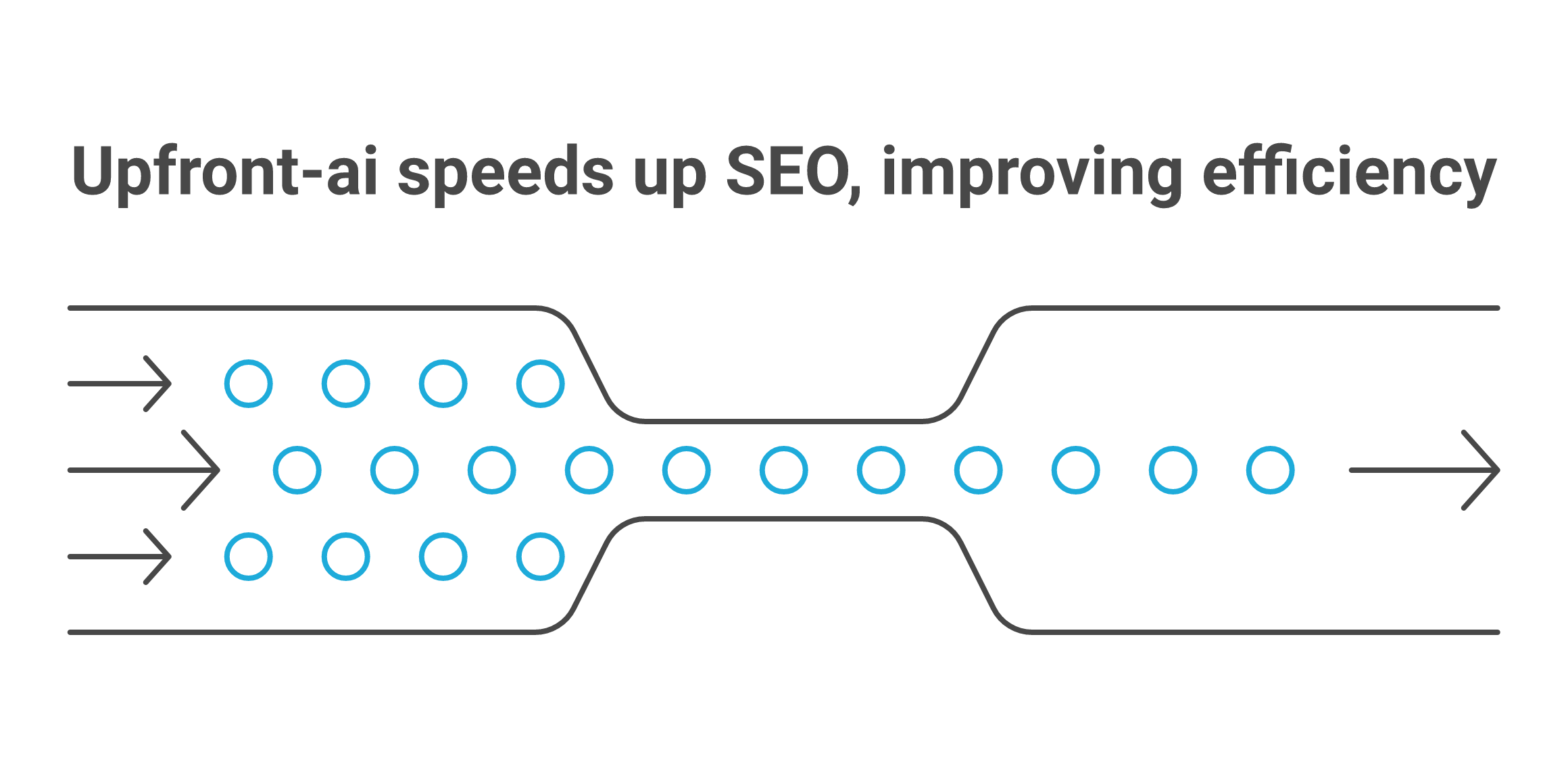
You will not have to choose. This tactical playbook shows how to automate SEO blogging so you produce people-first content at scale, preserve EEAT, and begin winning in both classic search and the new breed of answer engines. Upfront-ai has created a fully automated, fully customizable, AI agentic driven content solution to boost SEO, GEO (generative engine optimization), and AIO visibility ranking, citations and references for brands. It delivers ICP-focused, people-focused content using over 350 conversion-driven storytelling techniques. In today’s zero-click world, Upfront-ai’s platform ensures brands stand out and drive business growth by enhancing visibility in search engines and LLMs.
What you will learn
- How to build an automated pipeline that takes you from topic research to publish and iteration.
- How to keep human judgment where it matters while delegating repeatable tasks to AI.
- Which technical and editorial guardrails prevent hallucinations, thin content, and brand drift.
Questions to keep top of mind as you read
- How do you automate without losing your voice or credibility?
- Which parts of the workflow must stay human?
- What metrics actually prove the automation is working?
Table Of Contents
- Summary: The problem and what you will learn
- The problem: Why scaling SEO blogging fails for most teams
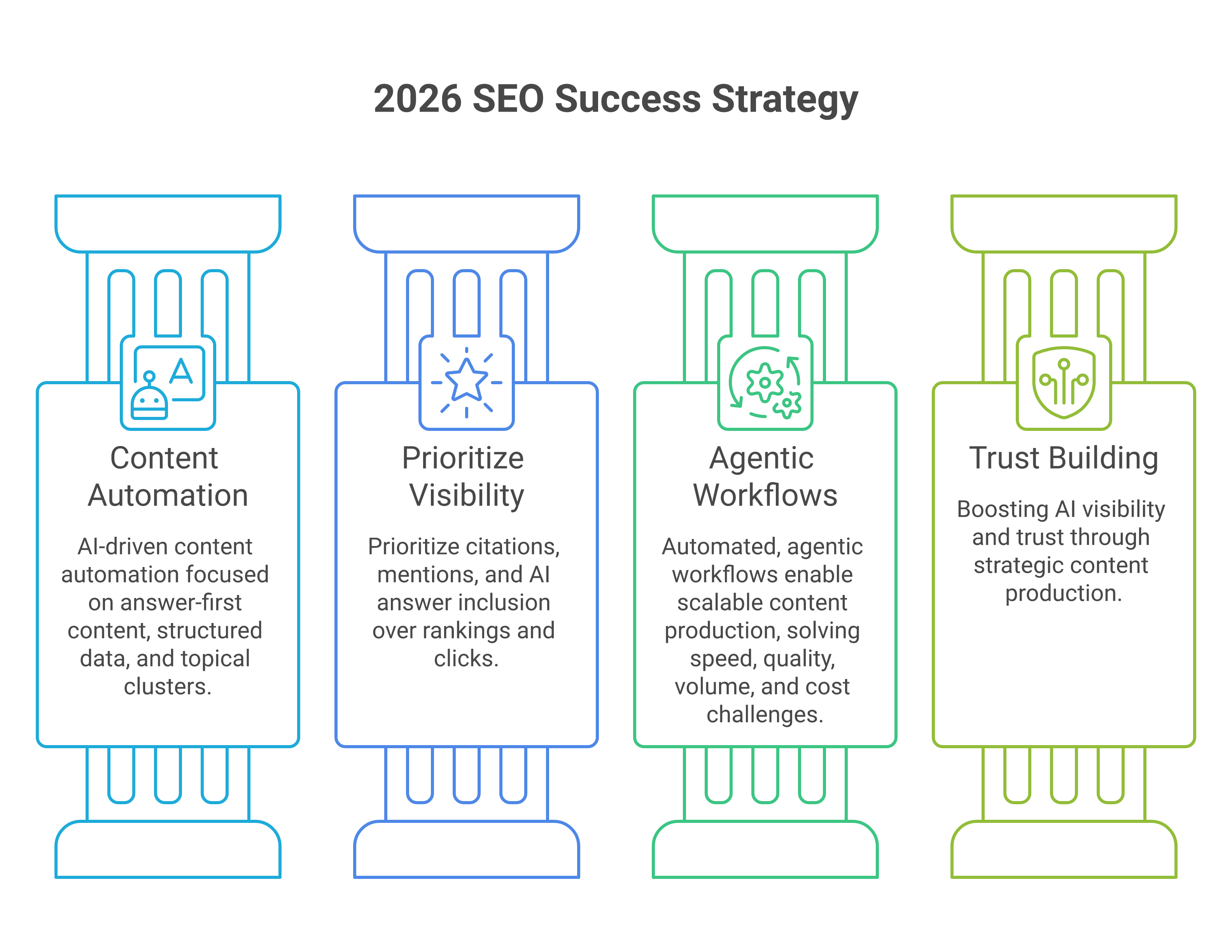
- Insight: The four pillars of successful automation
- The automated SEO-blogging pipeline (stage-by-stage)
- How to be ready for LLM citations (GEO tactics)
- Two opposing approaches, an instructive reflection
- Tactical how-to: Step-by-step implementation checklist
- Technical stack and integrations
- Measurement, benchmarks, and expected outcomes
- Case study snapshot
- 30/60/90 implementation roadmap
- Quick wins checklist
- Key takeaways
- FAQ
- About Upfront-ai
Summary: The Problem And What You Will Learn
You are running a small marketing team. You need steady, high-quality blog content to feed organic growth, nurture leads, and build topical authority. Hiring writers and SEO experts is expensive and slow. Throwing raw AI at the problem gives you volume but often yields thin, generic, or inaccurate articles.
In this article you will get a reproducible pipeline that combines an AI text generator, SEO accelerator tooling, and governance so your team can publish reliably, fast, and with measurable SEO and LLM visibility gains. You will see prompts, schema snippets, monitoring KPIs, and a 30/60/90 roadmap to deploy quickly.

A note on what AI tools can do Modern AI assistants can generate draft articles in minutes, maintain tone at scale, and reduce cost compared with large freelance networks. They are excellent at repetitive structure and content scaffolding, but they need curated inputs and human gatekeepers to maintain EEAT. For a quick industry roundup of what modern AI SEO tools offer, see this 2026 tools list that highlights automation, intent detection, and predictive analytics, and for a practical view on AI assistants that focus on speed, SEO optimization, and consistency, review this practical note on modern AI writing benefits.
- Industry roundup of AI SEO tools: Top AI SEO tools to automate your strategy in 2026
- Practical overview of AI writing benefits: Best AI tools for blog and content writing
The Problem: Why Scaling SEO Blogging Fails For Most Teams
You feel this as missed editorial calendars, inconsistent voice, and occasional ranking drops. The content trilemma, cost, speed, quality, haunts every plan. Add the new constraint, being visible to answer engines that extract short answers and cite sources, and the stakes rise.
Common failure modes
- Patchwork tool stacks, keyword tools, content editors, and CMSs that do not talk to each other.
- No single source of truth about products, claims, and allowed language, which creates legal risks.
- Over-automation where teams use AI to draft entire posts with no fact-checking, producing hallucinations or thin pages.
- Wrong formats for LLMs, long narrative posts with no TL;DR, no FAQ schema, and no short extractable answers.
Insight: The Four Pillars Of Successful Automation
If you automate incorrectly you accelerate bad content. Build these pillars first.
- One Company Model A single, machine-readable knowledge base that encodes brand voice, product facts, personas, allowed claims, competitive positioning, and legal guardrails. This is your North Star for every agent and prompt.
- AI agents for tasks Small, purpose-built agents handle ideation, brief creation, first drafts, meta tags, schema, and FAQ generation. Each agent gets a constrained prompt, output template, and a human reviewer in the loop.
- SEO accelerator technical stack Keyword research and intent mapping, content scoring, schema generation, and monitoring tools integrated with your CMS. This stack automates the repetitive on-page work and exposes data for iteration.
- Governance and EEAT Checklist-driven human review, mandatory source citations for claims, and an uncertainty flagging system so editors know where to fact-check.
The Automated SEO-Blogging Pipeline (Stage-By-Stage)
Think of the pipeline as a factory that still requires quality control stations.
- Market research and ICP Collect search intent and competitor gaps. Build topic clusters around buyer questions, not vanity keywords.
- Keyword and topic generation Use clusters that combine commercial intent, informational intent, and high-probability LLM citation formats, such as definitions, quick answers, and step lists.
- Title and brief creation An agent produces five headline options, a 100-word brief, target keywords, and suggested internal links.
- AI drafting A constrained writing agent produces a first draft, TL;DR, five FAQs, and a 40 to 60 word snippet formatted for AI extraction.
- Human review and enrichment Editor adds quotes, case snippets, data, and verifies sources. Mandatory EEAT checklist applied.
- On-page SEO and schema Automated insertion of JSON-LD for Article, FAQ, QAPage, and Author. H1 and H2 structure and meta tags generated.
- Publish and syndicate CMS automation schedules, social syndication webhooks fire, and outreach sequence for high-value posts starts.
- Monitor and iterate Measure SERP features, LLM citations, CTRs, and backlinks. Run content refreshes and headline A/B tests.
How To Be Ready For LLM Citations (GEO Tactics)
LLMs and AI overviews prefer short, copyable answers and clear sources. Make your content easy to extract.
- Start articles with a concise TL;DR, 20 to 40 words, that answers the core query.
- Add a Quick Answer box beneath the H1 for direct quoting.
- Publish FAQ and QAPage schema for common queries.
- Provide source links and a short methodology section for any original data.
- Use structured data, Article, Organization, Author, FAQ, QAPage, and Dataset where appropriate.
Two Opposing Approaches, An Instructive Reflection
Image 1: The automation-first approach You build agents to do ideation, drafting, meta tags, and even initial link suggestions. You publish faster, at lower cost, and with consistent structure. Strengths, velocity, predictability, and lower marginal cost per article. This works when your One Company Model is mature and you have strong human review at quality gates.
Image 2: The human-first approach You rely on skilled SEO writers and editors for ideation and drafting, using AI only for research snippets and outlines. Strengths, high initial quality and fewer compliance risks. The tradeoff, cost and slower throughput.
The reflection They appear opposed, speed versus craftsmanship, but they are mirror strategies. Automation-first trades time and cost for scale but depends heavily on governance. Human-first trades scale for precision but struggles to meet content velocity. The insight, combine them. Use automation for repeatable scaffolding, and keep humans for validation, nuance, and authority-building. That synthesis is the sweet spot.
Tactical How-To: Step-By-Step Implementation Checklist
6.1 Build your One Company Model
Where it lives, a versioned, machine-readable repo, JSON or YAML, accessible by agents.
What to include
- Persona profiles: job title, pain, priority metric, voice sample.
- Product fact sheet: features, release dates, pricing ranges, allowed claims.
- Brand voice rules: tone, words to avoid, sentence length.
- Linkable assets inventory: case studies, white papers, datasets.
- Compliance flags and legal boilerplate.
Example persona snippet
- Persona: Head of Product (SaaS)
- Pain: ship features on time, reduce churn
- Priority: product adoption metrics
- Voice: authoritative, direct, case-based
6.2 Automate ideation and title generation
Work from topics that map to intent. Generate 20 topic ideas per cluster, score by traffic potential and ease of ranking. Use templates such as, “How to [achieve result] without [common obstacle]” or “X ways to [improve metric] in [industry]”.
6.3 Prompt engineering and AI agents
Create reusable prompt templates. Keep them short, strict, and output-constrained.
Example prompt for first draft
- Role, Experienced SaaS content marketer
- Inputs, title, brief, target keywords, persona, TL;DR length
- Constraints, 800 to 1,200 words, include two data citations, three headings, deliver TL;DR in one sentence, include five FAQs.
Prompt for EEAT check
- Task, flag any claim without a URL and mark any numeric claim greater than 10 percent change as verify.
Prompt for FAQ generation
- Task, generate five user questions with concise one to two sentence answers and suggested schema-ready snippets.
6.4 Drafting that preserves EEAT and people-first storytelling
Never let the AI invent proprietary facts. Use the uncertainty flag approach, anything the model produces without a source is flagged for human review. Build a short case snippet format editors must fill, challenge, solution, outcome, metric. These lightweight vignettes make content feel human and credible.
6.5 On-page optimization and schema for GEO Essential elements
- H1 with primary keyword and intent clarity.
- Top-of-article TL;DR and Quick Answer.
- FAQ schema for the generated FAQs.
- Article schema with author, datePublished, and publisher.
- QAPage where you host long-form Q&A posts.
- Alt text and descriptive captions for images.
Sample JSON-LD (short) { “@context”: “https://schema.org”, “@type”: “Article”, “headline”: “Sample headline”, “description”: “Concise description”, “author”: { “@type”: “Person”, “name”: “Author name” }, “publisher”: { “@type”: “Organization”, “name”: “Your company” }, “datePublished”: “2026-01-01” }
6.6 CMS publishing and automation
Set up a draft pipeline, AI agent creates a draft, webhook routes it to editorial queue, human editor approves, automation inserts schema and schedules publish. For social and email syndication, use webhooks that trigger templated outreach and link outreach sequences.
6.7 Post-publish monitoring and iteration KPIs to track
- Organic ranking and featured snippet presence
- Organic sessions and CTR
- LLM citation count, manually check top AI overviews or create alerts
- Backlinks and referring domains
- Time-to-publish and cost-per-asset
Automate daily rank checks, weekly content scoring, and monthly refreshes for pages that lost CTR.
6.8 Risk management and governance
- Gate changes that could affect claims behind human approvals.
- Add an age-of-fact audit, any piece referencing fast-moving metrics needs a date and a review cadence.
- EEAT audit checklist at publication, sources present, author bio, methodology section if data used.
Technical Stack And Integrations
Core components
- AI text generator and agent orchestration, your automation engine.
- Keyword and intent tool, cluster and SERP gap analysis.
- Content scoring and audit tool.
- CMS with API or headless endpoints.
- Analytics and rank-tracking.
- Outreach and linkbuilding tool.
Architectural flow AI agents → content repo/One Company Model → CMS via API → publish → analytics and monitoring.
Example triggers
- New high-intent keyword appears, agent generates three briefs.
- Published article reaches CTR threshold, trigger outreach to previously identified prospects.
GEO-Specific Tactics To Win LLM Citations
- Provide extractable one to two sentence answers at the top of pages.
- Use FAQ and QAPage schema liberally.
- Publish original data and a methodology so LLMs have a unique source to cite.
- Ensure the text is server-rendered and crawlable, avoid JS-only content.
- Create a knowledge hub with tightly related posts to signal topical authority.
Measurement, Benchmarks, And Expected Outcomes
Typical benchmarks for a disciplined automation program
- Pilot, five high-quality articles in 30 days.
- Visibility, many teams see meaningful SERP movement in 45 to 90 days.
- Example target, 3.65X exposure growth in 45 days is an achievable visibility lift with a focused rollout and active linkbuilding, pilot outcomes depend on starting baseline and competitiveness.
Set dashboards that combine classic SEO metrics and GEO signals, featured snippets, People Also Ask, and manual checks of AI answer engines for candid citations.
Case Study Snapshot
A lean SaaS marketing team of 12 used an automated brief-to-publish pipeline. AI agents produced drafts and FAQ schema, while two editors validated facts. Within eight weeks they increased content velocity from two to ten posts per month, organic sessions rose 42 percent, and multiple posts began appearing in AI answer summaries. The secret, a strong One Company Model and strict EEAT checklists.
30/60/90 Implementation Roadmap
30 days
- Build One Company Model basics.
- Pilot five articles, ideation to publish.
- Add TL;DR and FAQ schema on pilot posts.
60 days
- Automate briefs to drafts and schema insertion.
- Start outreach sequence for cornerstone pieces.
- Implement monitoring dashboards.
90 days
- Scale content hub, iterate on headlines with A/B tests.
- Push for LLM citations through original data and FAQs.
- Measure velocity, cost per article, and organic performance.

Quick Wins Checklist
- Add a 20 to 40 word TL;DR to top-performing pages.
- Implement FAQ schema on at least five pages.
- Create three agent prompts, brief, draft, and EEAT check.
- Build a one-page One Company Model and store it in the content repo.
- Run an automated audit for missing citations.
- Schedule a weekly review for uncertainty-flagged claims.
Key Takeaways
- Build a One Company Model first. It is the backbone of reliable automation.
- Use AI agents to do repeatable work, keep humans for judgment and authority.
- Format content for both search and LLMs, TL;DR, FAQs, schema, and source links.
- Measure both classic SEO KPIs and GEO signals, iterate rapidly.
- Governance is not optional, EEAT checks and uncertainty flags are essential.
FAQ
Q: Will Google penalize AI-generated content? A: No automatic penalty if content is helpful, original, and accurately sourced. The problem is low-quality, unhelpful AI content. Apply EEAT checks and human review to avoid thin or misleading content.
Q: Which parts of the process should be fully automated? A: Automate ideation, brief creation, first draft scaffolding, meta generation, and schema insertion. Never fully automate facts, claims about product capabilities, or legal copy without human review.
Q: How fast will I see SEO improvements? A: You can see early visibility gains in 45 to 90 days for well-targeted informational queries. LLM citation gains can appear quickly if your content provides concise answers and unique sources.
Q: What KPIs prove the automation is working? A: Content velocity, time-to-publish, organic sessions, CTR improvements, featured snippet presence, LLM citation count, and cost-per-asset.
Q: How do I prevent hallucinations in AI drafts? A: Require sources for facts, use an uncertainty flag, and mandate human verification for any numeric or product claim.
Q: What schema types are essential for GEO? A: Article, FAQ, QAPage, Author, Organization, and Dataset, if you publish original research.
About Upfront-ai
Upfront-ai is a cutting-edge technology company dedicated to transforming how businesses leverage artificial intelligence for content marketing and SEO. By combining advanced AI tools with expert insights, Upfront-ai empowers marketers to create smarter, more effective strategies that drive engagement and growth. Their innovative solutions help you stay ahead in a competitive landscape by optimizing content for the future of search.
You have the tools and the knowledge now. The question is, will you adapt your SEO strategy to meet your audience’s evolving expectations? How will you balance local relevance with clear, concise answers? And what’s the first GEO or AEO tactic you’ll implement this week? The future of SEO is answer engines, make sure you’re ready to be the answer.