
It begins with a Slack message at 2 a.m.: your competitor’s name shows up in an AI assistant’s answer to a question that should have led prospects to your product. You scroll, blink, and realize your carefully carved SEO rankings do not matter if the generative engine is recommending someone else. That moment wakes you up to a simple, uncomfortable truth: being discoverable in search is no longer enough, you have to be discoverable in answers.
Summary of the problem and what you will learn
Old SEO metrics, rank and raw traffic, are necessary but insufficient. Generative engines and large language models add a new axis of visibility: will the engine cite your content as the concise, trustworthy answer? In this article you will learn how to measure modern success across SEO and GEO (generative engine optimization), which signals matter to LLMs and search engines, a practical 8-step playbook to scale, and an actionable KPI and measurement plan you can implement this week.
Table of Contents
- Executive TL;DR
- The Problem: Why Old SEO Success Definitions Fail
- What Success Looks Like Today – A Combined SEO + GEO Framework
- Signals LLMs and Search Engines Use
- KPIs and Measurement Plan
- Playbook: 8-Step Path to Predictable SEO + GEO Success
- How Upfront-ai Materially Changes the Equation
- GEO Tactics That Boost LLM Citations
- Measurement Examples and Templates
- Common Objections and Rebuttals
- Key Takeaways
- FAQ
- About Upfront-ai
Executive TL;DR
You need three outcomes to call your program a success: (1) consistent extractable answers, short machine-readable TL;DRs that feed AI overviews, (2) measurable increases in SERP feature share and LLM citations, and (3) clear business impact tied to content, such as MQLs or pipeline. Early wins show up fast, 30 to 45 days for snippet and extractable wins. Meaningful pipeline lift typically follows within 90 to 180 days with disciplined measurement and iteration.
The Problem: Why Old SEO Success Definitions Fail
You grew up measuring success with rank trackers and organic sessions. That model still matters, higher visibility still drives more eyeballs, but it no longer tells the whole story.
Why it fails now
- Zero-click searches and featured snippets absorb attention. The page view may never happen, but the user still consumes your brand’s answer, or they consume your competitor’s.
- LLMs and AI assistants synthesize across sources and create a single answer. If your content is not extractable or citation-ready, the assistant will favor sources that are easier to quote.
- Many teams still optimize for keywords in isolation. Generative engines reward concise, authoritative answer blocks, data, and explicit attribution more than keyword density.
This is not hypothetical. Industry observers have noted the visibility shift toward being cited inside AI answers; for context, read the recent Forbes article on why AI models sometimes recommend competitors in answers and how that can affect brands. For a wider view on how GEO is changing customer experience perceptions and the concept of being cited within AI-generated summaries, see the CX Network discussion about GEO and the invisible shelf.

Here’s why the situation needs resolving
If an AI assistant recommends your competitor in an early-stage exploration by a buyer, you lose the chance to shape the evaluation. That affects deal velocity and pipeline quality. For a B2B company with a small marketing team, every missed AI citation is a missed opportunity to seed the funnel.
What Success Looks Like Today -A Combined SEO + GEO Framework
Redefine success as a composite of five outcome categories. Each is measurable and ties back to business impact.
- Visibility
- Classic search: organic ranking for targeted clusters.
- SERP features: share of impressions for featured snippets, people also ask, and knowledge panels.
- Generative visibility: occurrences in LLM answers, AI Overviews, and assistant recommendations.
- Authority
- Backlinks from reputable sites.
- Named authorship and credentialed bios.
- Explicit citations and original data that invite attribution.
- Engagement
- Click-through rate from SERPs and feature panels.
- Time on page, scroll depth, and reduction in pogo-sticking.
- Engagement on republished summaries, for example on LinkedIn and partner sites.
- Business impact
- Content-driven MQLs, demo requests, and influenced pipeline.
- Conversion rates from content entry points.
- Average deal size change when content-assisted leads convert.
- Velocity and scale
- Cadence of published assets and update frequency.
- Coverage across ICP segments and key questions.
- Unit economics: cost per asset and cost per LLM citation.
Mapping to time horizons (practical expectations)
- 30 days: publish answer-first canonical pages and add schema, expect early impressions in PAA and occasional snippet tests.
- 45 days: initial SERP feature capture and the first LLM references in monitored assistants.
- 90 days: measurable organic traffic lift, backlinks to citation-worthy assets, and early MQLs.
- 180 days: sustained pipeline contribution and repeatable content velocity.
Signals LLMs and Search Engines Use
If you want to be the answer, you must be structured, concise, and authoritative. LLMs and search engines read similar signals, but they weight extractability and clarity far higher than ever.
Structural signals
- Schema: Article, FAQ, QAPage, and explicit JSON-LD summaries, to make content machine-readable.
- Headings and lead paragraphs: place a concise answer in a 40 to 60 word TL;DR at the top.
- Clear canonicalization and consistent URL structure across question pages.
Content signals
- People-first writing: clear posture for the reader, short paragraphs, evidence-first claims.
- Author bios: named experts with verifiable credentials and linked profiles.
- Citations and data: timestamped, source-linked statistics and research.
Behavioral and site signals
- Page experience: fast loading, mobile-optimized, accessible.
- Internal linking: robust hub-and-spoke clusters so engines see the topical entity.
- Freshness: update logs and last-updated timestamps for time-sensitive answers.
Semantic signals for GEO
- Canonical TL;DRs: short, factual, and easy to quote.
- Entity linking: consistent use of product and company names, industry terms, and schema-defined entities.
- Attribution language: explicit “Research by [company], [date]” lines that LLMs can surface as citations.
For a deeper read on GEO as a visibility shift and why being cited matters, explore the CX Network piece that frames GEO as being cited within AI-generated summaries and recommended responses.
KPIs and Measurement Plan
You need a blend of classic SEO metrics and GEO-specific measures. Track these consistently and link them back to business outcomes.
Primary KPIs (what to track and why)
- LLM citations / generative engine references: occurrences of your brand or URL mentioned in AI answers and assistant outputs, the new share-of-voice for answers.
- SERP feature share: percent of impressions where your pages appear in featured snippets, PAA, knowledge panels.
- Organic sessions and keyword visibility: clustered by ICP and intent.
- Conversions attributable to content: demo requests, MQLs, or contact forms originating from content pages.
- Quality citations/backlinks: number and authority of sites linking to your citation-worthy assets.
How to measure LLM citations practically
- Manual sampling: ask ChatGPT, Perplexity, and other assistants the same buyer-intent questions and document sources.
- Brand-mention monitoring: scrape answers and log which URLs are being referenced.
- Partner tools: leverage emerging vendors and APIs that scrape AI Overviews for citations.
Secondary metrics
- Click-through rates from SERP features.
- Scroll depth and time on page for TL;DR pages.
- Update frequency and content velocity metrics.
Recommended dashboards and cadence
- Weekly: SERP feature share and LLM mention sampling.
- Monthly: organic sessions, keyword cluster movement, and conversion attribution.
- Quarterly: pipeline influence, backlink growth, and content unit economics.
Playbook: 8-Step Path to Predictable SEO + GEO Success
This is a pragmatic sequence you can follow with a small team.
Step 1: Build a One Company Model
Consolidate your tone, proof points, personas, and canonical answers in a single content model. This guarantees consistency across thousands of pages.
Step 2: Target ICP-driven topic clusters
Map high-value buyer questions to topic clusters. For each cluster, define the primary question the LLM is likely to be asked.
Step 3: Create answer-first content blocks and TL;DR snippets
Start every page with a 40 to 60 word answer that directly responds to the question. Format it as an extractable block for LLM consumption.
Step 4: Apply EEAT and HCU in every asset
Add author bios, date, citations, and evidence. High-quality, useful content increases the odds of being quoted.
Step 5: Use structured schema and metadata
Implement Article, FAQ, QAPage, and a JSON-LD summary field. Make your content as machine-friendly as possible.
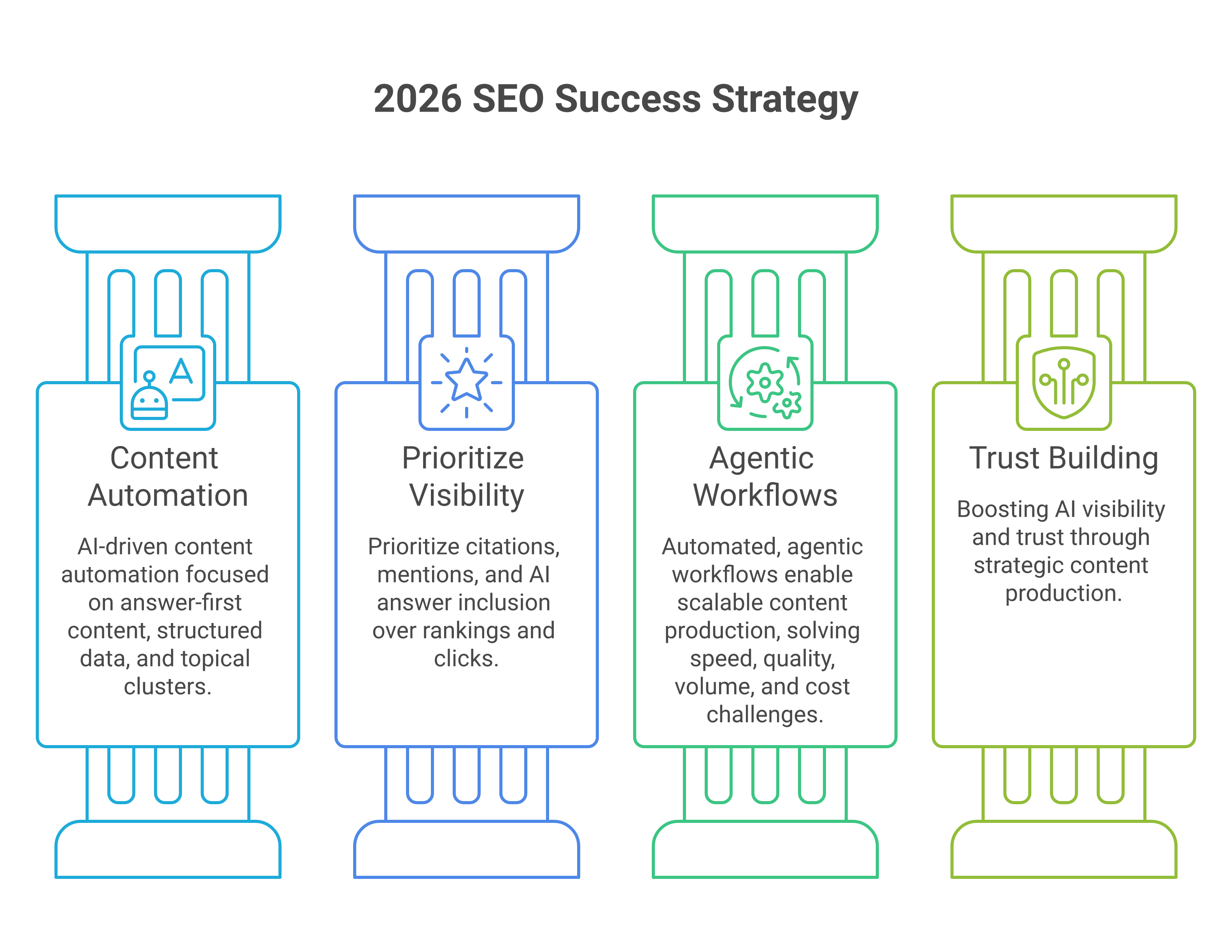
Step 6: Automate scale with AI agents
Use agent-driven ideation, drafting, and optimization with human governance to scale speed without sacrificing brand voice.
Step 7: Build citation-worthy assets
Publish original data, one-page templates, and studies that are inherently citable.
Step 8: Monitor, iterate, and scale
A/B title tags, refresh content, and redeploy winners into adjacent ICP clusters.
How Upfront-ai Materially Changes the Equation
Upfront-ai accelerates several steps in the playbook in ways that matter for teams with limited bandwidth.
- One Company Model: centralizes voice, personas, and canonical answers so every asset signals the same entity.
- AI Agents: automate ideation, drafting, and optimization to increase content velocity and reduce cost per asset.
- Storytelling techniques: apply a library of frameworks to raise engagement and retention.
- Integrated on-page SEO + schema: deliver extractable outputs that make it easier for LLMs to quote and cite.
Hypothetical vignette
Imagine a 30-person SaaS company that implemented the 8-step playbook. They published 200 GEO-ready pages in 60 days, each with a TL;DR, FAQ schema, and author bio. Within 45 days they observed a measurable lift in SERP feature share and began to see their domain appear in sampled AI assistant answers. Over 90 to 180 days, content-driven demo requests increased and backlinks grew to the most-cited assets.
GEO Tactics That Boost Likelihood of Being Cited by LLMs and AI Overviews
These are practical, copy-level tactics you can apply immediately.
- Publish concise answer-first paragraphs, 40 to 60 words, at the top of pages.
- Provide machine-readable summaries using JSON-LD summary blocks and FAQ schema.
- Offer original data, tables, and one-page templates with persistent URLs for citation.
- Create one-question canonical pages for high-value buyer intent.
- Maintain freshness and update logs with last-updated timestamps and a brief change summary.
- Add explicit attribution lines like “Research by [Company], [Month Year]” to make citing easier.
- Produce exportable citation cards: small embedded blocks, one to two sentences plus the canonical URL, designed for copy-and-paste citation by assistants.
Measurement Examples & Templates
Here is a simple KPI checklist to operationalize immediately:
KPI template (sample thresholds)
- SERP feature share: target 15 percent within 45 days for priority clusters.
- LLM mentions: 10 sample assistant queries show your domain in answers within 60 days.
- Content cadence: 10 GEO-optimized pages published per month.
- Backlinks: five authority backlinks to citation-worthy assets in 90 days.
- Conversions: two MQLs per month attributable to content in the first 90 days.
Snippet template (LLM-ready)
- 2 to 3 sentence TL;DR: start with the direct answer, follow with one supporting stat or citation, and finish with the canonical URL for attribution.
Common Objections and Rebuttals
“Automation lowers quality.”
Not if you govern it. Agentic workflows with human oversight and a One Company Model ensure scale and consistent quality.
“LLMs will replace SEO.”
LLMs change how answers are surfaced, but they do not replace site-level authority, backlinks, and experience. GEO complements SEO, prioritizing extractability and citation-ready content.
“We’re too small to compete for LLM citations.”
You can win by targeting high-intent niche questions unique to your ICP. Small teams that publish focused, well-structured canonical answers can out-cite larger brands because LLMs favor clarity and original data.

Key Takeaways
- Success equals visibility in both search and generative answers, not rank alone.
- Make pages extractable: concise TL;DRs, schema, author attribution, and original data.
- Measure LLM citations as a first-class KPI and tie content back to MQLs and pipeline.
- Use automation with governance to scale quality and cadence.
FAQ
Q: What is GEO and how does it differ from SEO?
A: GEO, or generative engine optimization, focuses on making your content extractable and citable by AI assistants and LLM-based overviews. SEO focuses on organic ranking and traffic. GEO complements SEO by prioritizing concise answers, machine-readable summaries, and explicit attribution that make your content more likely to be surfaced in synthesized answers.
Q: What are the top KPIs for measuring success in SEO and GEO?
A: Primary KPIs include LLM citations or generative engine references, SERP feature share, organic sessions for targeted clusters, and conversions tied to content. Secondary KPIs include engagement metrics like time on page and scroll depth.
Q: How long does it take to see results from GEO-focused content?
A: Expect early extractability wins within 30 to 45 days, when schema and TL;DRs are picked up in SERP features and occasionally in sampled AI answers. Meaningful pipeline impact typically emerges in 90 to 180 days when content has time to earn citations and conversions.
Q: Can automation deliver the same quality as manual content creation?
A: Yes, when you pair AI agents with human governance and a One Company Model to enforce voice, factual accuracy, and EEAT signals. Automation handles scale and iteration, humans ensure authority and brand fidelity.
Q: What content signals make LLMs more likely to cite a page?
A: Short answer-first paragraphs, JSON-LD summaries and FAQ schema, original data and tables, explicit attribution lines, author bios, and persistent URLs all increase the chance of being cited.
Q: How do EEAT and HCU affect LLM visibility?
A: EEAT, expertise, experience, authoritativeness, trustworthiness, and HCU, helpful content updates, are increasingly valued. LLMs and search engines favor sources with clear expertise, evidence, and up-to-date useful information.
About Upfront-ai
Upfront-ai is a cutting-edge technology company dedicated to transforming how businesses leverage artificial intelligence for content marketing and SEO. By combining advanced AI tools with expert insights, Upfront-ai empowers marketers to create smarter, more effective strategies that drive engagement and growth. Their innovative solutions help you stay ahead in a competitive landscape by optimizing content for the future of search.
You have the tools and the knowledge now. The question is, will you adapt your SEO strategy to meet your audience’s evolving expectations? How will you balance local relevance with clear, concise answers? And what is the first GEO or AEO tactic you will implement this week? The future of SEO is answer engines, make sure you are ready to be the answer.