
What if the next answer to your customer’s question is an AI, not a web page?
You still want that answer to point back to your brand.
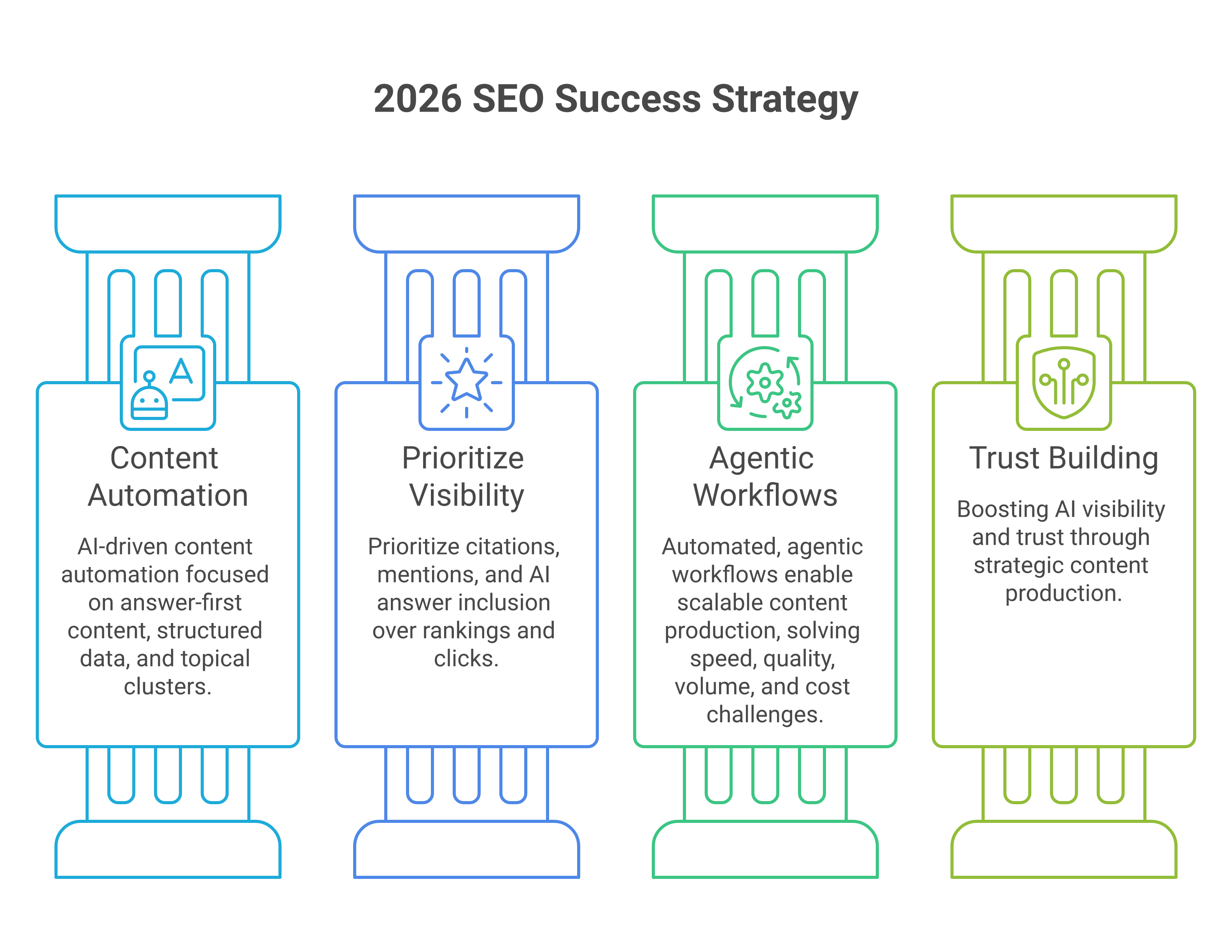
You are a CEO who must marry speed, scale, and credibility. AI gives you speed and scale, and SEO and trust give you credibility. The tricky part is doing both without hollowing out your brand voice or amplifying errors. This article provides a CEO-level playbook to deploy AI-driven content creation that boosts both traditional search rankings and visibility inside generative engines and AI overviews.
TL;DR
AI-driven content can cut production time and cost while increasing visibility in classic search and generative engine results. Act like a product leader: define a canonical brand model, map content to measurable business outcomes, deploy AI agents with EEAT and HCU guardrails, and track both SEO and AIO/GEO metrics. Expect initial lifts in impressions and snippet pickups in 30 to 45 days and meaningful traffic and lead gains in 90 to 180 days. Start a pilot to validate in 45 days.
One-sentence answer
Define authoritative, verifiable source data for AI to use, then operationalize agent workflows that produce people-first content with citations and measurable SEO and GEO signals.
Table of contents
- What problem you face and what you will learn
- Why you should care: stakes and signals
- Key considerations before you automate
- A CEO’s 6-step playbook to deploy AI content that ranks
- What people-first AI content looks like
- Mitigating risks and common pitfalls
- Measurement and ROI: short and mid-term wins
- Mini case example and timeline
- CEO checklist and 30/60/90 day plan
- Key takeaways
- FAQ
- About Upfront-ai
What problem you face and what you will learn
Your team is probably wrestling with three failures at once: deadlines slip, quality varies, and cost per piece balloons. At the same time, search is changing. Google and other engines are layering AI over results, providing one-sentence answers, AI overviews, and assistant responses that bypass clicks. If your content is not structured, citable, and trusted by AI systems, your brand loses discoverability even when demand is strong.
You will learn a practical, CEO-friendly framework to:

- Decide what to automate and what to keep human.
- Create governance and measurement that tie content to business outcomes.
- Deploy AI agents and technical SEO work that surface your content in both classic search and generative engines.
- Mitigate risks like factual errors and brand drift.
Why you should care: stakes and signals
Search is moving from keyword matching to context and trust. AI-driven search evaluates signals that go beyond raw keyword frequency, including topical authority, structured data, citations, and content provenance. Visibility is no longer earned by keywords alone, it is earned by trust, context, and authority interpreted by AI. For an industry perspective, see this Spinutech piece on winning visibility in AI-driven search: Five ways to win visibility in AI-driven search in 2026.
Business impact you should measure
- Visibility metrics: impressions, SERP features (snippets, knowledge panels), and AI overview pickups.
- Engagement metrics: CTR, time on page, and bounce rate for intent-matched pages.
- Outcome metrics: MQLs, demo requests, demo-to-close conversion, and churn influence.
CEOs should care because lost SERP real estate costs more than ad spend, it reduces pipeline and brand momentum.
Cost of inaction Let competitors capture the short, authoritative answers that users see first. As clicks shift toward AI answers and away from websites, you risk reduced organic traffic and weaker lead flow unless you create content that AI systems will cite and summarize.
Key considerations before you automate
Challenge: ownership is fuzzy, who is accountable for content outcomes? Response: assign executive ownership. Either the CEO or CMO should sign off on the content governance charter. Define who approves the One Company Model, the canonical set of product facts, ICP definitions, tone, and legal constraints.
Challenge: your brand facts are scattered across people and docs. Response: build a single canonical source of truth, a One Company Model, that feeds every AI agent and writer. This is not marketing fluff, it is product specs, pricing rules, approved claims, and customer evidence. When you are building that model, link governance to responsibilities and refresh cadence. See an internal example of this concept at the One Company Model page: /features/one-company-model.
Challenge: hallucinations and legal risk. Response: set hard guardrails, require source citations for every factual claim, require humans to sign off on high-impact pages, and maintain an audit trail for content production. Use explicit templates that demand citations and standardized author bios.
Challenge: metrics are messy and siloed. Response: define a KPI matrix that includes SEO metrics (rankings, organic sessions), GEO metrics (AI overview pickups, snippet appearance), and business metrics (MQLs, demo requests). Decide which of these are weekly operational metrics versus monthly outcome metrics.
The CEO’s 6-step playbook to deploy AI content that ranks
Step 1 – Define the One Company Model
Deliverable: canonical brand data store, including product facts, pricing, legal claims, ICP profiles, approved tone, and proof points. Make this the single input for every AI agent and content brief.
Operational tips
- Store it in a format agents can query: structured fields for product specs, Q&A pairs for common objections, and named-author attribution rules.
- Set ownership and a 90-day refresh cycle.
Step 2 – Map content to business outcomes
Deliverable: prioritized editorial roadmap that ties topic clusters to conversion outcomes.
How to do it
- Build an intent map: For each ICP and buying stage define the search intents you need to own, discovery, comparison, product detail, troubleshooting, and hiring.
- Prioritize topics by impact and ease, pick low-hanging FAQ pages and location or service pages that drive demo requests first.
- Include GEO targets, short extractable answers and structured Q&A that generative engines like to quote.
Step 3 – Implement AI agents with EEAT and HCU guardrails
Deliverable: agent workflows for ideation, research, drafting, citation, and human review.
Agent workflow example
- Ideation agent pulls topic cluster, search intent, and competitor SERP snapshots.
- Research agent fetches primary sources, approved company facts from the One Company Model, and outbound references.
- Draft agent produces a structured draft with a one-sentence answer, section summary bullets, and cite markers.
- Human editor verifies claims, updates tone, and publishes with author attribution.
- Post-publish agent generates microcontent for social, structured FAQ blocks, and submits sitemap updates.
Guardrails
- Force source citations for every claim.
- Require an author with verifiable credentials on strategic content.
- Implement a “no publish” rule for pages that make regulatory or legal claims without legal review.
Step 4 – Technical and on-page setup
Deliverable: standardized content template and JSON-LD snippets.
Essentials
- Schema: Article, FAQPage, HowTo, or QAPage where appropriate.
- One-sentence canonical answer at the top of the page to increase the chance of AI extraction.
- Modular templates: long-form pillar plus short FAQ modules that are easily updated.
- Site architecture: ensure topic clusters are internally linked and crawlable.
If you lack in-house technical skills, bring in technical audits and schema setup from specialists. See options for technical site audits and schema setup at our technical SEO services page: /services/technical-seo.
Step 5 – Publish cadence and distribution
Deliverable: consistent cadence that feeds both search and signal systems.
Tactics
- 2 to 4 cornerstone pages published and updated per month for mid-sized B2B.
- Immediately generate microcontent for LinkedIn, email, and partner channels to earn backlinks and citations.
- Use PR and partnerships to surface unique data or case studies that AI systems will treat as provenance.
Step 6 – Measure and iterate
Deliverable: a KPI dashboard split by short-term versus long-term indicators.
What to track
- Weekly: impressions, SERP feature appearances, CTR.
- Monthly: organic sessions by page cluster, featured snippet wins, and FAQ impressions.
- Quarterly: demo requests and pipeline influence from content-driven leads.
Tie these numbers back to revenue impact and adjust the editorial roadmap accordingly.
What people-first AI content looks like
People-first content is not a robotic output with a human name attached. It is content that answers user intent clearly, includes verifiable sources, carries author attribution, and tells story-driven customer examples.
Formats that perform
- Pillar long-form guides with one-sentence answers and short extractable bullets.
- FAQ hubs structured for both users and AI.
- Comparison pages and data-led case studies.
- How-to pages with step lists and clear outcomes.
Before and after example Before, plain auto-generated output
- Title: “How to choose a SaaS analytics tool”
- Content: generic listicle with no sources or company data.
After, agentic output with Upfront principles
- Title: “How to select a SaaS analytics tool for data-driven growth”
- One-sentence answer: “Pick the tool that matches your expected volume and reporting needs, and validate using two-week trials focused on your top three KPIs.”
- Short 3-bullet summary for AI extraction.
- Case vignette with metrics and a citation to an internal case study.
- Author bio with role and credentials.
People-first signals for AI
- Author attribution with a credible bio.
- Source citations and links to primary data.
- Internal linking to case studies and product pages.
- Structured FAQ that AI can quote.

Mitigating risks and common pitfalls
- Risk: hallucinations and factual drift. Fix: require the research agent to attach explicit source links and make human sign-off mandatory for claims about performance, pricing, and regulations.
- Risk: loss of brand voice. Fix: encode tone as structured tokens in the One Company Model and make a human editor the final arbiter on high-visibility assets.
- Risk: over-automation. Fix: keep humans in loops for audience-facing content and automated agents for routinized production such as first drafts and microcontent.
Measurement and ROI: short and mid-term wins
Short-term wins (30 to 45 days)
- Increase in impressions and visibility in FAQ and rich snippet slots.
- Faster time-to-publish for repeatable, low-risk pages.
Mid-term wins (90 to 180 days)
- Organic traffic lift and featured snippet wins.
- LLM and AI overview citations increase as your one-sentence answers and structured Q&A are picked up.
- Case-study impact: measurable pipeline influence when content targets decision-stage queries.
KPI dashboard sketch Weekly
- Impressions for targeted topics.
- SERP feature presence per page.
Monthly
- Organic sessions by cluster.
- CTR changes on targeted titles.
- Snippet capture rate.
Quarterly
- MQLs from content-driven pages.
- Demo requests and SQL conversions.
- Backlink velocity for cornerstone content.
Real-world case example
A mid-market SaaS firm worked with an automated content program and focused on three priority clusters: buyer comparisons, implementation FAQs, and performance case studies. By building a One Company Model, instituting agent workflows with mandatory citations, and updating schema-rich FAQ modules, the firm achieved measurable gains.
Results summary (anonymized)
- 3.65x exposure in 45 days for targeted FAQ clusters, measured by impressions and SERP features.
- Featured snippet wins for two priority product comparison queries in 90 days.
- 28 percent lift in demo requests attributed to content-driven landing pages in 120 days.
If you want to see how a program like that would map to your product and ICP, review performance case studies at our case studies page: /case-studies.
CEO checklist and 30/60/90 day plan
30 days
- Appoint an executive owner and sign the governance charter.
- Assemble the One Company Model and name data owners.
- Pilot a single topic cluster with agent-assisted drafts and human approval.
60 days
- Standardize templates and schema for the pilot pages.
- Publish pillar content plus FAQ modules and generate microcontent for social.
- Set up KPI dashboard and weekly reporting.
90 days
- Analyze snippet capture, organic traffic, and demo influence.
- Expand to 3 to 5 clusters based on ROI.
- Formalize rollout budget and plan a 6-month cadence.
Key takeaways
- Tie AI outputs to authoritative inputs, your One Company Model is the single most important asset.
- Measure both classic SEO metrics and GEO/AIO metrics, impressions and AI overview pickups matter.
- Use an agent plus human workflow, automation scales but humans preserve trust and accuracy.
- Structured, extractable content increases the chance AI systems will cite and summarize your pages.
FAQ
Q: How quickly can AI-driven content improve SEO visibility? A: Expect initial visibility and impression gains in 30 to 45 days for FAQ and snippet-targeted pages. Meaningful organic traffic and lead impact typically take 90 to 180 days, depending on domain authority and distribution efforts.
Q: Can automation preserve brand voice and EEAT? A: Yes, if you encode brand voice and EEAT/HCU rules into a One Company Model and make human editors the final approvers for high-impact content. Guardrails and verification steps are essential.
Q: What metrics should CEOs monitor for AI content programs? A: Weekly, monitor impressions and SERP feature presence. Monthly, track organic sessions and CTR by cluster. Quarterly, measure MQLs, demo requests, and pipeline influence from content pages.
Q: How do AI agents prevent factual errors and hallucinations? A: Through mandatory citation requirements, human verification workflows, and by sourcing facts from your canonical One Company Model rather than relying on open internet queries alone.
Q: What content formats drive the most AI citations? A: Short, extractable formats, one-sentence answers, FAQ blocks, clear how-to steps, and data-led case studies are most often quoted by generative engines.
Q: Do I need in-house talent to use automated AI content tools? A: You need someone who understands editorial strategy and governance, plus a technical resource for schema and deployment. Many firms combine in-house strategy with a platform partner for scale.
About Upfront-ai
Upfront-ai is a cutting-edge technology company dedicated to transforming how businesses leverage artificial intelligence for content marketing and SEO. By combining advanced AI tools with expert insights, Upfront-ai empowers marketers to create smarter, more effective strategies that drive engagement and growth. Their innovative solutions help you stay ahead in a competitive landscape by optimizing content for the future of search.
Further reading
- For more context on how AI is changing search and why trust matters, read the Spinutech article: Five ways to win visibility in AI-driven search in 2026.
- For industry adoption perspectives and practical implications for SEO, see this ElearningIndustry write-up: SEO and AI in 2025, adapt or get buried in the search results.
If you want, I can now draft the HowTo JSON-LD for the 6-step playbook, create the 30/60/90 day CEO checklist PDF, or prepare a pilot scope that maps to your top three ICP topics. Which would you like first?