
Have you tested whether your content answers the question before the user even finishes asking it?
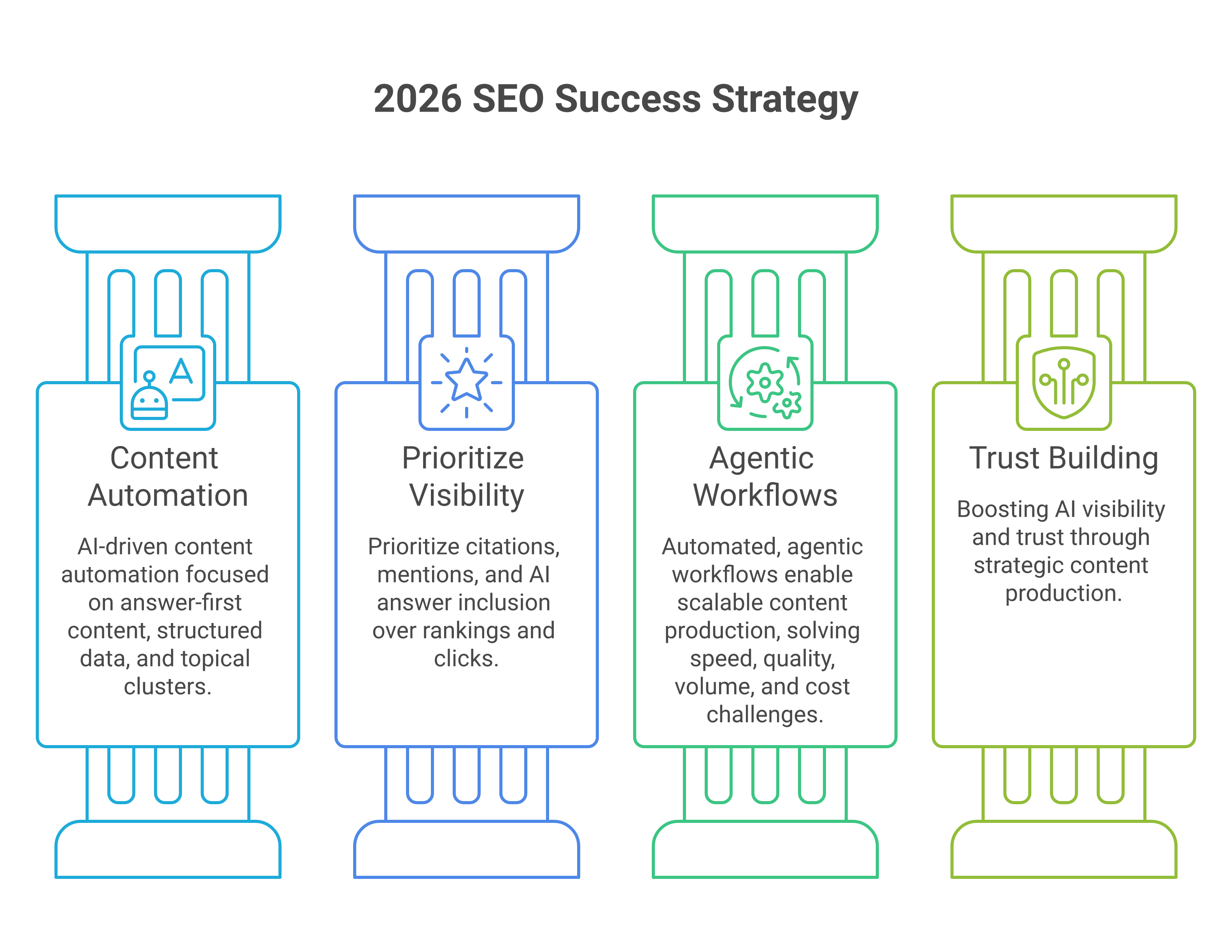
You are competing not just with other websites, but with large language models, answer engines, and a rising expectation that search delivers a short, definitive answer instantly. This changes how you plan, produce, and measure content. Read on and you will learn a practical six-step path to scale AI content automation for SEO, protect your brand, and earn citations from AI overviews and chat-style search.
Summary of the problem and what you will learn
Search is shifting from keyword-first discovery to answer-first consumption. Brands that rely purely on manual content workflows cannot keep up with demand for frequent, authoritative, and snippet-ready answers. You will learn how generative AI and agentic automation can produce content at scale without sacrificing accuracy or EEAT, how to optimize for both traditional SERPs and the new generative engines, the risks to watch for, and a hands-on 45-day playbook you can run this month.
Quick action checklist for CMOs
- Audit one vertical or property this week for snippet opportunities.
- Pilot a 45-day AI-driven sprint focused on three high-intent topics.
- Add JSON-LD FAQ and Article schema to priority pages before publishing.
Table of contents
- Why This Matters Now
- What Is AI Content Automation And Generative AI Content?
- How Generative Content Impacts SEO And LLM Visibility
- Common Risks And Failure Modes And How To Avoid Them
- A Practical Six-Step Implementation Framework
- GEO Tactics To Get Cited By AI Overviews And LLMs
- Examples And A 45-Day Sprint Playbook
- Governance, Safety, And Quality Control
- Measurement And ROI Model
- Key Takeaways
- FAQ
- About Upfront-ai
Why This Matters Now
You do not operate in a static search landscape. Google, Microsoft, Perplexity, and others are weaving generative models into search experiences, producing AI Overviews and chat-style answers that often appear above traditional organic results. For context, recent reporting highlights that Google’s AI mode has already reached tens of millions of users, so generative answers are not niche anymore; see ALMCorp’s summary of recent platform activity for context and timelines ALMCorp summary of recent search platform activity.
What this means for you is simple and urgent: if your content cannot deliver concise, reliable, and easily citable answers, you risk losing attention and even referral traffic. At the same time, brands that adapt can win free backlinks and appear within AI Overviews. For practical tactics and ecommerce-specific GEO guidance, review this explainer on generative engine optimization, which details machine-readable signals and product data strategies Salsify guide to generative engine optimization for ecommerce.
What Is AI Content Automation And Generative AI Content?
Definition and scope
- AI content automation for SEO means using generative models plus automated workflows to create, optimize, and publish content at scale, while enforcing brand, legal, and accuracy guardrails.
- Generative AI content refers to outputs from large language models: long-form articles, FAQ blocks, product descriptions, microcopy, and structured answer snippets.
Types of automation
- Template-driven generation, where fill-in-the-blank frameworks produce repeatable content such as product pages and FAQs.
- Agentic workflows, autonomous chains that produce outlines, draft content, run fact checks, and format for CMS with human checkpoints.
- Data-backed generation, where models are fed canonical datasets, case studies, and official sources to reduce hallucinations.
Where automation helps and where humans must remain
- Automate speed, drafts, indexing metadata, bulk schema generation, and repetitive microcopy.
- Keep humans in the loop for subject-matter vetting, legal compliance, narrative storytelling, and final sign-off on claims that affect reputation or regulation.

How Generative Content Impacts SEO And LLM Visibility
Two sets of signals you must satisfy
- Traditional SEO signals: links, on-page relevance (title tags, H1), page speed, mobile UX, canonical authority, and topical depth.
- Generative engine signals: clarity, concise answerability, structured data, verifiable facts, authoritativeness, and snippetability.
EEAT and HCU remain front and center
Google’s Helpful Content and the industry’s EEAT expectations mean that even AI-assisted content must be demonstrably helpful and authored or verified by experts. Models will surface concise answers first, so if your content looks like thin, unverified AI output it will not be trusted or cited.
What GEO requires
Generative engine optimization prioritizes short, machine-friendly answers plus source-level trust signals. GEO rewards content that is accurate, concise, and mapped to machine-readable formats and product data, which can enable inclusion in AI Overviews and free backlink opportunities. The practical guides above explain how to structure product and information pages for these outcomes.
Common Risks And Failure Modes And How To Avoid Them
Hallucinations and factual errors
- Problem: models invent facts or misattribute findings.
- Why it matters: you damage trust, risk compliance breaches, and lose EEAT.
- Prevention: require human verification of every claim, attach citations from canonical sources, and maintain a versioned fact repository.
Thin or duplicative content
- Problem: mass-generated pages that add no unique value.
- Why it matters: Google’s helpful content systems demote thin content.
- Prevention: prioritize high-intent pages, consolidate overlapping pages, and apply people-focused storytelling templates to add unique perspective.
Over-optimization and keyword stuffing
- Problem: robotic keyword stuffing to game rankings.
- Why it matters: hurts UX and triggers algorithmic penalties.
- Prevention: adopt natural language prompts that prioritize clarity and answer quality; monitor on-page keyword density and user engagement metrics.
Poor page experience and indexability
- Problem: content published as images or slow-loading JS-only renderings that block crawler access.
- Why it matters: LLMs and search need accessible text and structured data.
- Prevention: ensure server-side rendering or prerendered HTML, fast TTFB, and inclusion in sitemaps and open index endpoints.
A Practical Six-Step Implementation Framework
Step 1: Audit And Baseline
Action points
- Technical audit, to crawl and identify indexing issues, canonical conflicts, and page speed offenders.
- Content audit, to score pages by traffic, conversions, topical gaps, and snippet share.
- LLM visibility audit, to track which pages are already getting featured snippets, People Also Ask answers, or LLM citations.
Tools and outputs
- Produce a prioritized list: top 50 pages to optimize for GEO, top 100 keywords by intent, and 20 content gaps for long-term authority.
Step 2: Define The One Company Model
What it is and why it matters
Create a centralized company knowledge profile with brand voice, tone, canonical sources, product facts, legal dos and donts, and author credentials. The One Company Model prevents inconsistency, reduces hallucination risk by constraining models to your verified facts, and speeds up scale by making brand rules machine-readable.
Practical elements
- A one-page canonical sources list.
- Standardized author bios with credentials and links.
- Brand archetype rules and sample copy.
Step 3: Strategy And Topic Selection
Prioritization matrix
- Rank topics by commercial intent, GEO opportunity (snippetability), topical authority, and linkability.
- Aim for a mix: 30 percent transactional/commercial, 50 percent mid-funnel how-to and category authority, 20 percent research and case studies.
Title and format planning
- Use a title matrix that maps nine thought leadership pillars against 35 formats, including how-to, listicle, product comparison, research, case study, FAQ, checklist, and schema-first article.
Step 4: Production: Agentic AI Workflows Plus Human Validation
A reliable pipeline
- Outline, draft, automated fact-check, human expert edit, SEO polish, schema injection, publish.
- Embed EEAT prompts into drafting agents, such as instructing them to cite primary sources, include author credentials, and mark speculative language.
Human touches that matter
- Storytelling hooks from structured techniques. Add a quote, a short case vignette, or a specific metric to transform a generic draft into a shareable resource.
- For regulated content, require a signed compliance stamp before publishing.
Step 5: On-Page And Technical Optimization
Checklist
- Title tags, with the primary keyword in the first 60 characters.
- H1 and H2 hierarchy, and a short definition plus 1–2 sentence answer at the top.
- Schema, including Article, FAQ, HowTo, BreadcrumbList, Organization, and QAPage as relevant.
- Machine-readable fact box, a JSON-LD snippet containing top claims and metrics.
Snippet-friendly layout
- Short, bolded answer boxes of 1–2 sentences under each H2.
- Numbered checklists and step sequences for easy extraction by LLMs.
Step 6: Amplification, Links, And Measurement
Distribution and link strategy
- Internal linking hubs to your pillar pages.
- Outreach for authoritative backlinks using data and case studies.
- Syndication on LinkedIn and industry newsletters to increase crawl spread to generative engines.
KPIs to track
- Organic traffic and conversion rates.
- Featured snippet share and People Also Ask coverage.
- LLM citations and inclusion in AI Overviews.
- Time to first citation and uplift in assisted conversions.
GEO Tactics To Get Cited By Google AI Overviews And LLMs
Make answers short and citable
- Start sections with a one-line definition and a 2–4 bullet key takeaway to provide prime fodder for LLM answers.
Add structured data
- Implement JSON-LD for Article, FAQ, HowTo, and Organization. Use a machine-readable fact box with top metrics and sources.
Provide authoritative signals
- Full author bios with credentials and links.
- Research pages and downloadable datasets in CSV or JSON so models can pull facts.
Quotable blocks and timestamping
- Include answer boxes under 50 words and date-stamped research to increase freshness signals.
Examples And A 45-Day Sprint Playbook
Example sprint, 45 days – what you publish and measure
- Week 1: Audit and One Company Model
Deliverables: content and technical audit report, canonical sources list.
KPIs: list of 25 target pages and 10 GEO opportunities.
- Week 2–3: Topic selection and templates
Deliverables: 12 prioritized topics, templates for How-to, FAQ, and pillar pages.
KPIs: titles queued for drafting, JSON-LD schema templates completed.
- Week 4–6: Production and publish
Deliverables: publish 8 articles, add schema, outbound citations.
KPIs: impressions, clicks, and featured snippet attempts.
- Week 7: Measurement and iteration
Deliverables: 45-day report and optimization plan.
KPIs: ranking lifts, featured snippet wins, and LLM mentions measured via brand monitoring.
Hypothetical results
- A mid-market SaaS that ran a 45-day sprint focused on three product categories could see a 3x increase in topical impressions and earn two AI Overview citations for product comparison answers. These results are illustrative; your outcomes will depend on baseline authority and execution.
Governance, Safety, And Quality Control
Fact-checking workflow
- Automated checks, using citation matchers that flag claims without source links.
- Human checks, where SMEs verify technical claims and editors sign off on narrative and legal aspects.
Versioning and refresh policy
- Archive pages older than 18 months, or refresh with updated data and new citations.
- Maintain a changelog and visible last-updated timestamp.
Compliance checklist
- For healthcare, finance, or legal topics, require citation to peer-reviewed sources, explicit disclaimers, and legal review.
Measurement And ROI Model
Short-term vs long-term KPIs
- Short term, 30 to 90 days: impressions, featured snippet wins, clicks, and content velocity.
- Long term, 6 to 12 months: topical authority, organic conversions, and LLM citation growth.
Sample ROI calculation
- Cost: AI tooling plus human editorial hours.
- Benefit: incremental organic revenue from new conversions attributable to optimized pages.
- Model: measure incremental traffic times conversion rate times LTV, subtract incremental cost, and reassess quarterly.

Key Takeaways
- Optimize for both traditional SEO and generative engines, combining short, citable answers with deep, authoritative content.
- Build a One Company Model to keep AI outputs factual, consistent, and brand-safe.
- Implement an agentic workflow that pairs AI speed with human verification to avoid hallucinations and thin content.
- Use schema and concise answer blocks to increase the chance of being cited in AI Overviews.
- Run a focused 45-day sprint to prove value, then scale using data and governance.
FAQ
Q: Will AI-generated content get penalized by Google? A: Not inherently. Google’s enforcement is about helpfulness and trustworthiness, not the tool used to create content. If AI-generated pages are low-quality, unhelpful, or deceptive, they risk demotion. Your defense is clear author attribution, verifiable sources, and human verification.
Q: How do I avoid hallucinations in AI-generated content? A: Constrain models to your One Company Model and canonical sources, require citation for every factual claim, and use automated source-checking followed by SME validation. Disallow unsourced assertions in production workflows.
Q: What content types work best for getting cited by LLMs and AI Overviews? A: Concise definitional answers, numbered step-by-step checklists, FAQ blocks, and data-backed claim boxes that are short and quotable. Use machine-readable schema to make extraction easier.
Q: How fast can I expect results from AI-driven content automation? A: You can show early signals in 30 to 90 days, such as impressions and featured snippet attempts. Meaningful ranking and conversion lift usually takes 3 to 6 months depending on domain authority and link building.
Q: What schema should I add first? A: Start with Article and FAQ schema, then add HowTo, BreadcrumbList, Organization, and QAPage as relevant. A small machine-readable fact box for top metrics is high ROI for GEO.
Q: How do I combine human editors with AI tools effectively? A: Use AI for drafting, metadata, and schema. Require human editors for fact-checking, narrative enhancement, and compliance. Define sign-off gates and SLAs for each content class.
About Upfront-ai
Upfront-ai is a cutting-edge technology company dedicated to transforming how businesses leverage artificial intelligence for content marketing and SEO. By combining advanced AI tools with expert insights, Upfront-ai empowers marketers to create smarter, more effective strategies that drive engagement and growth. Their innovative solutions help you stay ahead in a competitive landscape by optimizing content for the future of search.
You have the tools and the knowledge now. The question is, will you adapt your SEO strategy to meet your audience’s evolving expectations? How will you balance local relevance with clear, concise answers? What GEO or AEO tactic will you implement this week? The future of SEO is answer engines, make sure you are ready to be the answer.