
“Can you be the answer people see first?”
Search is rewriting how attention is earned. GEO, Generative Engine Optimization, and AIO, AI/Answer-engine Optimization, are the new priorities you must master if you want your content to be the one cited inside AI answers and still win organic clicks. You need people-first content that LLMs can trust, structural signals that machine readers understand, and a production system that scales without sacrificing accuracy or brand voice. Upfront-ai is built to do exactly that, with a One Company Model, governed AI agents, and workflow steps that translate into measurable lifts, including a company-stated 3.65X exposure improvement inside 30 to 45 days when pilots are run properly. Read on to learn the building blocks you must put in place to raise GEO and AIO rankings, how they connect, and the exact tactics you should implement this week.
Table of contents
- What you are facing now: why GEO and AIO matter
- Definitions: what GEO and AIO actually are
- Why old SEO habits will not be enough
- Block 1: One Company Model, why it anchors everything
- Block 2: AI agents and governed automation
- Block 3: Research, citations and fact-first content
- Block 4: Technical SEO, schema, and machine-readable signals
- Block 5: Content hubs, clusters, and internal linking
- Block 6: Distribution, links, and external authority
- Block 7: Measurement and KPIs you must track
- Implementation plan for small teams, timeline and milestones
- Risks, mitigations, and compliance controls
- Key takeaways
- FAQ
- Final prompt question to act on
- About Upfront-ai
What you are facing now: why GEO and AIO matter
You are competing for attention in two places at once, the classical search engine results and the new generative answer surfaces that return direct replies to user queries. LLMs and AI overviews now extract answers and sometimes do not send users to your page at all. That changes the game. The content that wins is the content that is structured, transparently sourced, fresh, and clearly attributable to an author and organization. If you do not tune for that, you will lose impressions, clicks, and trust.
Definitions: what GEO and AIO actually are
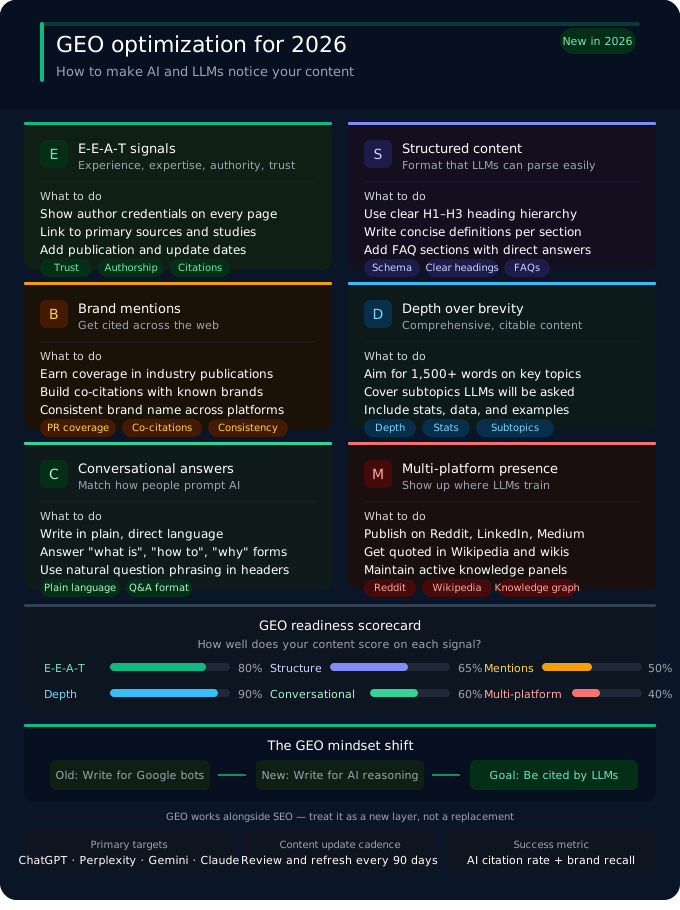
GEO, or Generative Engine Optimization, is the practice of structuring and enriching content so generative models and LLM-powered assistants can confidently surface and cite it. AIO, or AI/Answer-engine Optimization, is the narrower practice of shaping content specifically to be selected as the authoritative answer by AI-driven features like Google’s AI overviews or assistant cards. Both rely on the same fundamentals: factual accuracy, structured formatting, topical depth, author and organization signals, and citations.
If you want a practical primer on GEO, review the Upfront-ai primer on GEO optimization, which explains how to make LLMs notice your content.

Why old SEO habits will not be enough
Traditional SEO still matters, but it is incomplete. You must keep keywords and backlinks, while also adding:
- citation-first research blocks, because LLMs favor sources they can reference;
- machine-readable schema, so answer engines can parse your content easily;
- author and organization attribution, which raises trust signals for AI.
Industry writers and practitioners are already pointing out how AI is shifting content roles and toolsets. Analysts note that AI tools can do a large share of optimization tasks but require governance and strategy, as discussed in the Digital Coolie analysis on SEO and AIO trends. Others warn about declining organic CTRs as AI summaries replace traditional clicks, making structured answer optimization urgent, a trend covered by StoreTransform trends on GEO, AEO, and AIO.
Block 1: One Company Model and why it anchors everything
What it is: The One Company Model is your single source of truth for brand voice, customer profiles, product nuances, and company priorities. It is a living document that your content automation references every time a piece is created.
Why it matters: LLMs and answer engines prefer consistent, attributable signals. When every article, FAQ, and guide uses the same terminology, tone, and positioning, you reduce contradictions and establish a traceable authoritativeness across topics.
Action you should take this week: audit your brand voice and fill gaps in a One Company X-ray. Gather five buyer personas, three problem statements per persona, brand tone rules, and a 1,000-word product narrative for agents to reference.
Block 2: AI agents and governed automation
What it is: AI agents are automated components that handle ideation, research gathering, drafting, and on-page optimization. Governance layers enforce fact-checking, helpful content principles, and EEAT checks.
Why it matters: You need scale without sacrificing accuracy. Agents give you speed. The governance layer keeps outputs reliable and brand-safe.
How they connect: Agents use your One Company Model to stay on brand. They pull sources and attach citation blocks which then get verified by humans. That loop reduces hallucination risk and speeds delivery.
Practical tip: set guardrails that require at least three verifiable sources for any factual claim over a 10-word threshold, and require a human reviewer for claims that affect conversions or product instructions.
Block 3: Research, citations and fact-first content
What it is: Citation-first content places verifiable sources at the heart of claims. It uses inline source blocks, numbered references, and clear methodology statements.
Why it matters: LLMs and answer engines are increasingly selective about what they cite. If your content provides clear sources, structured evidence, and author context, it is more likely to be surfaced.
Action plan: adopt a standard template for long-form pieces that includes a methodology box, a citations list, and an author credentials section. Use primary sources where possible, and label company-stated metrics clearly.
Citation-first practices are widely recommended across SEO thought leaders and industry blogs, and you should mirror those methods while ensuring brand alignment via your One Company Model.
Block 4: Technical SEO, schema, and machine-readable signals
What it is: Machine-readable markup, clean HTML, and page experience elements that help crawlers and parsing engines understand your content.
Why it matters: Structured data such as Article, FAQ, Organization, Person, and QA JSON-LD make it easy for answer engines to extract facts and attribute them to your site.
Core actions: implement FAQ schema on Q&A pages, add Article schema for long-form content, include Organization and Person schema with contact and credential fields, and validate everything with structured data testing tools.
Pro tip: place citation blocks as explicit link lists and include publication and last-updated timestamps. Freshness is a strong signal for generative engines.
Block 5: Content hubs, clusters, and internal linking
What it is: Content hubs are thematic clusters built around a pillar page and supporting deep articles.
Why it matters: Topical authority emerges when many well-linked pages cover a subject in depth. Internal linking helps both classic search crawlers and LLM extractors see the topical breadth and depth.
How to implement: define a pillar topic, produce 8 to 12 supporting pages in 30 to 45 days, add consistent internal links and a cluster navigation menu, and ensure every page carries contextual signals from the One Company Model.
Example you can copy: run a 45-day cluster for a product vertical. Publish 12 pieces including FAQs, how-tos, and case-style explainers. Measure impressions, featured snippets, and any AI-answer citations that surface.
Block 6: Distribution, links, and external authority
What it is: Traditional link-building plus visibility strategies for platforms that feed generative models.
Why it matters: Outside citations and high-quality backlinks remain signals of trust for both search and AI systems.
Tactics: pursue targeted PR, guest articles on industry sites, and curated citations in research databases. Track brand mention velocity and authoritative links as early indicators of topical trust.
Caveat: balance automation with human outreach. Automated outreach can scale link acquisition but must not compromise brand safety.
Block 7: Measurement and KPIs you must track
What to measure: organic impressions, average rank, featured snippet capture rate, and organic CTR remain table stakes. Add the following GEO/AIO-focused metrics:
- AI citation count, where you can detect it;
- LLM impression spikes after major content pushes;
- indexing velocity for new content;
- dwell time and conversion rate for pages that AI surfaces.
Target milestones: run a pilot for 30 to 45 days. With a focused cluster and aggressive distribution, Upfront-ai reports a company-stated 3.65X exposure lift in that window. Use that as a benchmark, not a promise, and measure weeks 2, 4, and 6 for momentum.
Implementation plan for small teams, timeline and milestones
- Phase 0, week 0 to 1: onboarding and One Company X-ray. Collect personas, brand rules, product details, and target KPIs.
- Phase 1, week 1 to 2: strategy and content plan. Build a 45 to 90 day editorial calendar with pillar pages and clusters.
- Phase 2, week 2 to 6: automated production and publication. Use AI agents to research and draft, apply human review, inject schema, and publish.
- Phase 3, week 4 to 10: link-building and distribution. Launch backlink campaigns and PR pushes, measure indexing speed and early AI mentions.
- Phase 4, ongoing: measurement and iteration. Refine prompts, rewrite underperforming pages, and expand clusters based on LLM citation signals.
Example milestones to track each phase: baseline impressions, publish count, internal links added, featured snippets captured, AI mentions detected, and conversion lift. A realistic pilot might publish 12 validated long-form pieces and gain meaningful visibility within 30 to 45 days.
Risks, mitigations, and compliance controls
Risk: hallucinations and incorrect claims. Mitigation: force-source policies for claims, human verification for any conversion-impact content, and a rollback plan if an article is flagged.
Risk: brand tone drift. Mitigation: strict One Company Model enforcement and pre-publication QA.
Risk: privacy or regulatory issues. Mitigation: map content to corporate data governance, exclude sensitive PII from automated research, and maintain an audit trail for sources used.
How the blocks connect to form the full picture
The One Company Model gives AI agents a stable reference. Agents produce citation-first drafts that are wrapped in schema and published into content hubs. Distribution and links create external authority. Measurement feeds back to the agents, which then refine prompts and outputs. That loop lets you scale content while keeping accuracy and brand safety intact. Each block is necessary. Miss one, and your system will be slower, less trusted, or invisible to answer engines.

Key Takeaways
- Build a One Company Model first, then automate with guardrails to keep brand and facts aligned.
- Prioritize citation-first, structured content and implement Article, FAQ, Organization, and Person schema.
- Run a 30 to 45 day pilot with a focused content cluster, publish frequently, and measure AI citations and impression velocity.
- Pair automated production with human verification to prevent hallucinations and maintain EEAT.
- Track GEO/AIO-specific KPIs, including AI citation counts, indexing speed, and featured snippet capture rate.
FAQ
Q: How fast will I see GEO or AIO improvements?
A: You can expect initial signals within 30 to 45 days if you run a focused pilot with a content cluster, schema, and distribution plan. Early wins usually include indexing improvements, increased impressions, and occasional featured snippets. AI citation growth can lag or vary by vertical, so measure both search and AI-answer signals over at least six weeks before drawing conclusions. Use the first 45 days to validate your processes and guardrails.
Q: What content formats perform best for AI answers?
A: Short, scannable formats like Q&A pages, numbered lists, and clearly labeled FAQ sections tend to be extracted more reliably by answer engines. Long-form, citation-rich articles still matter because they supply depth and references. Combine both: short answer snippets for immediate surfacing, plus long-form evidence for authority.
Q: How do I prevent AI hallucinations in automated content?
A: Enforce a sourcing requirement for factual claims, use human reviewers for high-impact content, and implement prompt templates that instruct agents to only use verifiable references. Add a methodology box and citations block to every article. Also, treat company-stated performance metrics transparently and provide access to source documentation for verification.
Q: Are there external resources I should read to align my strategy?
A: Yes, review current industry analyses and practical guides to understand how SEO and AI tools are shifting. For example, read the Digital Coolie analysis on SEO and AIO trends and the StoreTransform trends on GEO, AEO, and AIO for broader context and tactical guidance.
You have the tools and the knowledge now. The question is: Will you adapt your SEO strategy to meet your audience’s evolving expectations? How will you balance local relevance with clear, concise answers? What is the first GEO or AIO tactic you will implement this week?
About Upfront-ai
Using Upfront-ai is a cutting-edge technology company dedicated to transforming how businesses leverage artificial intelligence for content marketing and SEO. By combining advanced AI tools with expert insights, Upfront-ai empowers marketers to create smarter, more effective strategies that drive engagement and growth. Their innovative solutions help you stay ahead in a competitive landscape by optimizing content for the future of search.