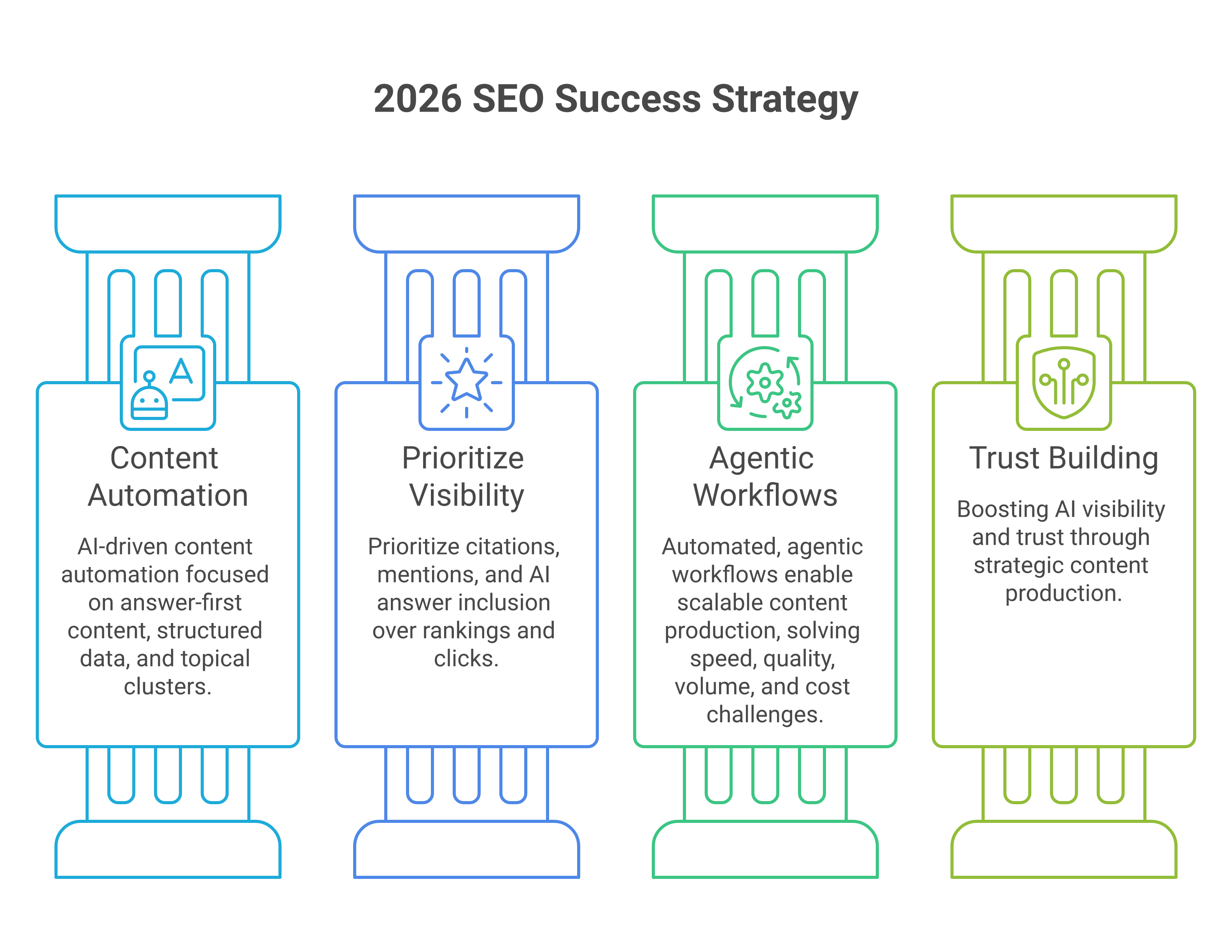

Announcement: search is changing now, and your content strategy must change with it.
Introduction Search engines and answer engines now reward content that answers people quickly, demonstrates clear expertise, and carries trust signals. AI tools amplify reach and speed, but they do not remove the need for human judgment. By the end of this guide you will have a repeatable, step-by-step process to write SEO content with AI-driven tools, create snippet-ready short answers, and measure impact in a 45-day playbook. You will know which wins appear in days, which metrics require months of steady work, and how to prevent AI hallucinations while scaling output.
This article uses real figures and examples, draws on recent industry reporting, and explains the method I use with small marketing teams. It gives concrete steps you can execute this week to increase visibility in search engines and large language models.
Table Of Contents
- What Ai-driven Seo Content Means Today
- Key Principles For Writing Seo Content With Ai
- A Repeatable Ai-driven Workflow: Step-by-step
- Tactical Recipes And Examples
- Content Scale Without Losing Quality
- Kpis And A 45-day Playbook
- Common Pitfalls And Solutions
- Short Term, Medium Term And Longer Term Implications
- Key Takeaways
- Faq
- About Upfront-ai
What Ai-driven Seo Content Means Today
Ai-driven SEO content uses machine intelligence to speed research, generate structured drafts, and produce schema, while humans retain editorial control. It is not a license to publish unchecked outputs. AI is best used to automate repetitive items such as ideation, keyword clustering, and schema generation. Humans must set the One Company Model inputs, verify facts, and tune voice.
Generative engines are changing discovery. Traditional search still matters, but AI-first systems and chat interfaces now synthesize answers from multiple sources. If your page offers concise, sourced answers and clear structure, it has a higher chance of being cited by those systems. For a practical overview of how to design pages that get cited by AI search, see this practical overview of optimizing content for AI search engines, which explains why well-structured pages get cited and how to design short answers for snippet-ready surfaces practical overview of optimizing content for AI search engines.
In today’s zero-click world, an AI-led content approach must surface immediate, trusted answers for people and for machines. Focus on short answers, trustworthy citations, and an architecture that supports both human readers and model crawlers.

Key Principles For Writing Seo Content With Ai
People-first editorial Put the reader first and keep sentences compact. Start with a short answer, then expand. If intent is quick information, the user needs a 40 to 80 word answer at the top of the page. If the intent is decision-making, add case studies and proof points.
Intent mapping Map each keyword to a clear intent label. Do not mix informational queries and transactional CTAs in the same short-answer block. Each page must have a primary intent and supporting intents.
Evidence and citations AI can invent facts. Always require three reputable citations for any claim that is not proprietary. Inline citations increase the chance of being trusted by models and by editors.
Structured answers and schema Add a short answer, a concise FAQ block and JSON-LD for FAQ schema. Structured content is easier for AI crawlers to extract and helps your chances of appearing in featured snippets.
Technical performance Fast loading, accessible markup, and clear HTML text matter. LLMs and AI bots prefer pages that expose readable text rather than images of text or heavy client-side renderings.
Brand voice and conversion focus Keep coherence by locking brand tone into the One Company Model. Every AI output must be edited to reflect your voice and to lead readers toward clear next steps.
A Repeatable Ai-driven Workflow: Step-by-step
What you will achieve by following these steps You will produce search-optimized, snippet-ready articles that are people-first, fact-checked, and ready for AI citation. You will shorten time to publish, reduce human hours spent on drafting, and improve the quality of your short answers that target featured snippets and answer engines.
- Step 1: Create your One Company Model Start with a single document that captures market position, customer profiles, tone of voice, product differentiators, and spokespeople. Example: a B2B company serving 10 to 100 employee firms notes core ICP pain points, three proof points, and founder bios. Lock these inputs into your AI agents as immutable prompts so every asset uses the same framework.
- Step 2: Ideation and title selection Generate 30 headlines across formats. Use AI to pull related keyword clusters, then filter by intent and click potential. Real-life example: a small SaaS firm used AI to generate 25 targeted headline variants, then ran a CTR test on two meta titles. The winning title produced a 22 percent higher click-through rate within one week.
- Step 3: Keyword research and intent mapping Cluster keywords by intent. For each cluster define the short answer and the supporting sections. Record target snippets and potential FAQs. Industry data suggests about 35 percent of businesses now incorporate AI into their SEO workflows, which supports automated clustering and faster discovery of long-tail intent. See this industry perspective on SEO and AI in 2025 for context on adoption and strategic urgency industry report on SEO and AI in 2025.
- Step 4: Outline generation with story arc Ask the AI agent to produce a context, problem, solution, proof, and CTA structure. Pick one storytelling technique to humanize the narrative. Example story arc: start with a quick stat, explain a common mistake, show a solution, then present a short case study.
- Step 5: Drafting with AI agents and human editor Use controlled prompts that require citation slots and flags for unsupported claims. The AI generates an initial draft and FAQ suggestions. A human editor then verifies data, inserts proprietary metrics, and polishes CTAs.
- Step 6: On-page optimization Create an H1 that matches intent, a 50 to 60 character title tag, a 140 to 160 character meta description optimized for CTR, and image alt text that explains visuals. Inject FAQ JSON-LD. Ensure canonical and optimized URL structure.
- Step 7: Technical checks and accessibility Run Core Web Vitals scans. Ensure first contentful paint is fast. Confirm mobile rendering and readable HTML text. Fix robots and allow AI-specific crawlers unless you have a specific reason to restrict them.
- Step 8: Publish and distribute Publish with structured data and share on owned channels. Use targeted syndication for niche hubs. Track which publishers pick up your content for early backlinks.
- Step 9: Link-building and citation outreach Create a short outreach template that highlights the data or quote and asks for a reference link. For powerful requests include a 100 word quote from a company spokesperson to make it easy to cite.
- Step 10: Measurement and iteration Track impressions, CTR, featured snippets, organic clicks, dwell time, backlinks and conversions. Use AI agents to run A/B tests on meta titles and regenerate short answers based on performance data.
- Step 11: Scale with guardrails Lock brand templates, add an editorial checklist, and maintain mandatory human sign-off for claims and CTAs.
Tactical Recipes And Examples
Eight Headline Templates For B2B How to [achieve X] without [undesired Y] The complete guide to [topic] for [audience] 7 proven ways to [outcome] in [timeframe] [role]’s playbook: [topic] Why [common belief] is wrong about [topic] [metric] benchmarks for [industry] in [year] Step-by-step: implement [solution] in [X steps] Case study: how [company] achieved [result] with [approach]
Sample prompts you can reuse Use the One Company Model, then ask for a 40 to 60 word snippet summary, three evidence sources that include exact URLs, and five FAQs. Demand that the AI return unsupported claims as highlighted items for a human to verify.
Schema example and FAQ block Generate an FAQ block of four to six questions as JSON-LD and inject it adjacent to the short answer. That increases your chance of being featured in snippet slots and cited by answer engines.
Real-life example A team that adopted AI-assisted outlines and enforced a human review step reported a rapid jump in impressions. In one reported case, a publisher saw clicks grow 1,300 percent in seven months after combining AI ideation with human editing and focused distribution. That outcome is possible when you blend AI speed with editorial rigor and targeted outreach.
Content Scale Without Losing Quality
Lock the voice Store brand voice and messaging in the One Company Model. Make it the first parameter in every prompt.
Automate repeatable elements Let AI generate metadata, alt text, and schema. Humanize the lead paragraph and verify facts.
Editorial gatekeeping Require a human editor to check citations, numbers and CTAs. Use checklists that include a three citation requirement, FAQ schema, and Core Web Vitals pass.
Team structure For small teams, assign one person to own the One Company Model and one editor to spot-check outputs. Use AI to produce drafts, but keep a final manual pass before publish.

Kpis And A 45-day Playbook
Days 0 to 7, immediate Publish snippet-optimized answers and meta title variants. Expect early impressions and potential featured snippets in days. Monitor CTR and impressions hourly at first, then daily.
Days 7 to 30, medium Run CTR and title tests. Begin outreach for backlinks and quote requests. Look for increases in dwell time and small organic traffic lifts.
Days 30 to 45, longer Track backlink acquisition, sustained ranking changes, and conversion lift. If you used controlled experiments, you may see a measurable exposure uplift. A platform framing used in industry suggests a 3.65 times exposure improvement when all elements align, though results vary by industry and baseline.
Metrics to watch Impressions, CTR, featured snippets, organic clicks, dwell time, backlinks, and conversions. Use AI reporting agents to surface anomalies and suggest title tweaks.
Common Pitfalls And Solutions
- Pitfall: Thin AI-only content Solution: require three citations and a human sign-off before publish.
- Pitfall: Inconsistent voice Solution: the One Company Model is mandatory for every prompt.
- Pitfall: Stale research Solution: schedule an automated research sweep that pulls new citations monthly.
- Pitfall: Missing schema Solution: auto-inject FAQ JSON-LD at publish time.
- Pitfall: Poor page performance Solution: run Core Web Vitals checklists and defer heavy scripts.
Short Term, Medium Term And Longer Term Implications
Short term implications You will see faster draft output, more headline variants, and early impressions for snippet-optimized answers. Expect initial wins in CTR and featured snippets within days.
Medium term implications Within weeks to a few months you will build topical authority, earn backlinks, and see steady traffic growth. Your editorial team will refine AI prompts and reduce revision time.
Longer term implications Over many months your site can accumulate the trust signals that AI answer engines and traditional search use to cite and surface your content. Long-term benefits include authoritativeness, repeat citations by models, and sustainable conversion lifts.
Key Takeaways
- Produce short, sourced answers at the top of each page and back them with structured content and FAQ schema.
- Lock your brand voice into a One Company Model that is passed to every AI prompt.
- Require human editorial sign-off for claims, citations, and CTAs before publish.
- Measure aggressively for snippet wins in days, and for conversion and authority gains across 30 to 45 days.
- Automate metadata and schema, but do not automate fact checking.
Faq
Q: Will ai content be penalized by search engines?
A: Not if it is edited, fact-checked and people-first. use ai to scale research and drafts, then require a human editor to verify facts, add original insights and format the page for snippets. include at least three reputable citations for claims and add author attribution. these steps preserve eeat and reduce the risk of penalties.
Q: How do i optimize for ai search versus traditional seo?
A: Optimize both by structuring content for short answers and adding robust supporting sections. short answer snippets help ai systems and featured snippets. add faq schema and clear citations so ai crawlers can extract trustworthy text. also maintain technical best practices for page speed so crawlers can index quickly.
Q: How quickly will i see results from ai-driven seo work?
A: Some signals such as impressions and featured snippets can appear in days after publish. meaningful organic ranking and conversion gains typically require weeks to months. use a 45 day playbook to iterate titles, test ctas, and pursue outreach for backlinks.
Q: What are the most common ai-related risks and how do i mitigate them?
A: Risks include hallucinated facts, inconsistent voice and thin content. mitigate by requiring citation rules, storing brand voice as a single source of truth and enforcing human editorial sign-off. schedule automated research updates and periodic audits.
About Upfront-ai
Using Upfront-ai is a cutting-edge technology company dedicated to transforming how businesses leverage artificial intelligence for content marketing and SEO. By combining advanced AI tools with expert insights, Upfront-ai empowers marketers to create smarter, more effective strategies that drive engagement and growth. Their innovative solutions help you stay ahead in a competitive landscape by optimizing content for the future of search.