
“Do you want to be the answer people find when they ask their phones a question?”
You face a simple but brutal problem: you must produce high-quality content fast, and your team is small. Search has shifted. Results now prioritize instant answers, snippets, and AI overviews. That means your brand needs content that is concise, well-sourced, and structured to be picked up by both search engines and AI answer systems. In practice you can solve this without hiring an army. You can use an easy AI SEO platform to automate ideation, research, drafting, schema, and measurement while keeping people-first storytelling at the center. Customers report rapid visibility uplifts; some see as much as 3.65X exposure in 45 days when they pair a disciplined content model with automation.
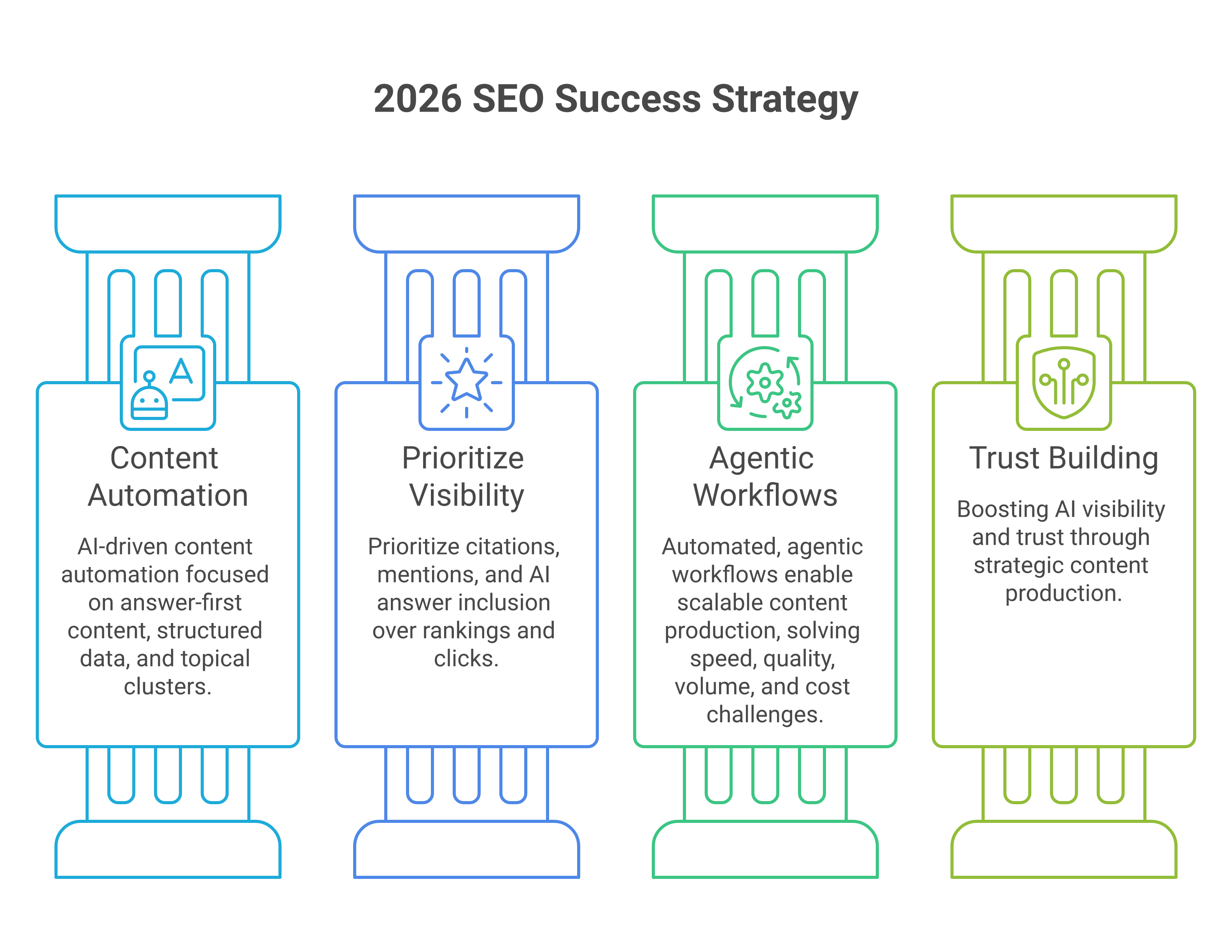
Upfront-AI has created a fully automated, fully customizable, AI agentic driven content solution to boost SEO, GEO (generative engine optimization), and AIO visibility ranking, citations and references for brands. It delivers ICP-focused, people-focused content using over 350 conversion-driven storytelling techniques. In today’s zero-click world, Upfront-AI’s platform ensures brands stand out and drive business growth by enhancing visibility in search engines and LLMs.
In this article you will get a clear, practical playbook. You will learn why AI plus GEO matters now. Walk through seven immediate strategies you can implement this week. Simple checklist to follow and the first task to start with. Along the way I cite industry data that shows AI summaries and AI-ready content are altering click behavior, and I point you to tools that help you craft and test AI-friendly pages.
Table Of Contents
- Why Modern SEO Needs AI And GEO
- The Upfront-AI Approach, One Platform, Five Outcomes
- Tactical Playbook, Seven AI SEO Strategies You Can Implement Now
- Realistic Outcomes And Timeline
- Implementation Checklist, Simple Tasks To Get Rolling
- Key Takeaways
- FAQ
- About Upfront-ai
- Final Question
Why Modern SEO Needs AI And GEO
Search used to be about keywords and backlinks. Those are still important. Today search is also about being the concise, trustworthy answer an AI will surface. Recent industry reporting shows AI-written pages are appearing in a growing share of top results, and over 88 percent of searches that trigger AI overviews are informational, which changes click behavior and brand exposure. You can no longer assume that a user will visit your page to get the answer. Instead your content must be designed so that both a search engine and a large language model can extract, summarize, and cite your work.
Traditional content pipelines break this requirement into silos. Researchers gather facts. Writers draft. Engineers publish. That takes time. AI-enabled platforms collapse the workflow by generating and verifying factual blocks, applying EEAT and helpful content rules, and formatting outputs with schema and answer-first snippets. The result is content that is faster to produce, easier to update, and more likely to be picked up by AI overviews. Tools that pair content editors with AI-driven fact insertion also help you optimize specifically for AI answers, making experimentation simple and measurable.

The Upfront-AI Approach, One Platform, Five Outcomes
You want speed without compromising trust. A platform that solves this has five core features.
- One company model
Create a living dossier that holds your brand voice, buyer personas, banned phrases, product differentiators, core data points, and topical priorities. This model becomes the single source of truth for every piece of content. It stops drift and reduces editing cycles. - AI agents that automate the pipeline
AI agents can run competitive gap analysis, propose topic clusters, fetch source documents, draft copy, and run EEAT and helpful content checks. Human editors remain in the loop for verification and brand nuance. This mix scales output while protecting quality. - Storytelling at scale
You still need human-first stories. Use formulaic storytelling templates that wrap data in a human frame. That combination increases engagement and sharability, and it creates linkable assets that earn authority. - Technical SEO and schema
Structure for both SERPs and LLMs. Add FAQ schema, article and author markup, clear H1 to H3 hierarchy, and TL;DR answer snippets at the top of pages. These elements help search engines and answer engines parse and cite your content. - Page experience and measurement
Deliver fast, readable HTML text pages, publish on a steady cadence, and measure impressions, snippet wins, and answer engine citations. A feedback loop lets you A/B test headings, TL;DR snippets, and schema treatments.
Tactical Playbook, Seven AI SEO Strategies You Can Implement Now
Strategy 1: Build a one company model
What it is: Centralize your brand rules and data so every asset uses the same facts and voice.
How you do it: Document buyer personas, set content priorities, record common objections, and list primary metrics for each asset.
Immediate win: Reduce content review time by 30 to 50 percent by removing repeated brand questions from editors.
Strategy 2: Use AI agents for ideation, research, and drafting
What it is: Set up automated workflows that generate topic idea packs, pull source citations, and draft outlines for human writers.
How you do it: Configure agents to run competitor gap analysis, customer question mining, and long-tail keyword discovery. Require source links and a single human sign-off before publishing.
Immediate win: Generate 20 to 50 vetted ideas per week without manual brainstorming.
Strategy 3: Prioritize GEO, structure content for answers and citations
What it is: Write pages that answer specific questions in a short lead, with supporting evidence blocks for AI to cite.
How you do it: Start each page with a one- or two-sentence TL;DR answer, include numbered takeaways, and add a short reference list or data table near claims.
Immediate win: Pages with clear answer snippets are more likely to be surfaced in AI summaries and featured snippets.
Strategy 4: Optimize on-page and schema for both SERPs and LLMs
What it is: Apply FAQ schema, article and author markup, and explicit QA pages where users ask questions.
How you do it: Add structured metadata, clear H hierarchy, and context-rich alt text. Validate schema with your developer tools and monitor coverage in search console.
Immediate win: Adding FAQ schema and clean metadata often increases SERP real estate and click-through rate.
Strategy 5: Publish with cadence and freshness signals
What it is: Schedule a regular publishing cadence and automated refresh logic for cornerstone content.
How you do it: Use your platform to update facts and timestamps for pillar pages weekly or monthly based on data changes.
Immediate win: Automated refreshes produce faster reindexing and maintain the relevance answer engines look for.
Strategy 6: Build linkable assets and citation-worthy content
What it is: Create original research, toolkits, and evergreen guides that other sites and AI models want to cite.
How you do it: Combine proprietary data with clear visualizations, and distribute the asset through outreach and PR.
Immediate win: A single data-rich asset can generate dozens of natural citations and referral links.
Strategy 7: Measure and iterate with AI-driven analytics
What it is: Track a small set of KPIs, test hypotheses often, and scale winners quickly.
How you do it: Focus on impressions, featured snippet captures, long-tail ranking lifts, LLM mentions, and conversions. Run A/B tests on snippet text and schema use.
Immediate win: Run three micro-experiments per month and double down on treatments that move impressions.
Practical Tooling Note
Some modern content editors and SEO tools also include AI features that pull facts and suggest optimizations to rank in both search and AI answers. For a practical example of a workflow that integrates AI-assisted fact insertion and optimization, see Surfer SEO’s 2026 AI SEO workflow. For broader industry data on AI summaries and informational queries, consult SEMrush’s AI SEO statistics.
Realistic Outcomes And Timeline
What you can expect and when.
0 to 30 days
You set up a one company model, run a gap analysis, and publish 3 to 5 optimized pages. Indexation begins and impressions appear for long-tail queries.
30 to 90 days
You see measurable increases in impressions and long-tail rankings. Early featured snippet captures occur. AI/answer engine detection begins for pages built with TL;DR snippets and strong citations.
3 to 6 months
You grow keyword footprint, earn more authoritative links, and accumulate LLM citations. Conversion improvements follow as content becomes both discoverable and trustworthy.
Implementation Checklist, Simple Tasks To Get Rolling
Goal: get a replicable, automated content engine running so you win both classic search and AI answer visibility.
Why a checklist works
A checklist breaks the workflow into atomic tasks you can assign, measure, and repeat. It reduces context switching, limits scope creep, and creates momentum. You will use each completed task as a stepping stone to the next, and every task produces measurable outputs you can iterate on.
- Task 1: create your one company model
Document your personas, core data points, brand voice rules, banned phrases, and primary conversion goals. That single document will seed topics and shape every brief. - Task 2: configure AI agents and run a content gap analysis
Set up agents to collect competitor topics, customer questions, and search intent signals. Use the results to build a prioritized list of pillar topics and supporting posts. - Task 3: produce a pillar page with a clear TL;DR answer
Write a concise answer-first intro, add supporting evidence blocks, and include a short reference list with links to primary sources. - Task 4: add schema and on-page technical elements
Implement FAQ schema, article markup, author tags, and clear H1 to H3 structure. Validate schema and monitor errors. - Task 5: publish and schedule automated refreshes
Set rules to refresh facts and update timestamps on pillar pages monthly or when data changes. - Task 6: create one linkable asset and start outreach
Publish an original study or toolkit, and begin targeted outreach to earn citations and backlinks. - Task 7: measure, run experiments, and iterate
Track impressions, snippet wins, LLM mentions, and conversions. Run small A/B tests and scale what works. - Final task: roll out the production loop
Move from pilot to production by automating idea packs, assigning editor review windows, and scheduling weekly publishing. Rinse and repeat, increasing volume while keeping human verification in place.

Why Finishing The Checklist Matters
Completing this checklist converts ad hoc content work into a reproducible engine. You gain speed, consistency, and measurable outcomes. When you finish, your team spends less time on operational tasks and more time on insight and strategy.
Key Takeaways
- Prioritize answers, not only keywords, to win AI overviews and featured snippets.
- Centralize brand rules in a one company model to reduce friction and increase consistency.
- Automate ideation and fact collection with AI agents, but keep a human verifier for EEAT.
- Use simple schema, TL;DR answer snippets, and reference blocks to boost citation chances.
- Measure a few signals, run micro-experiments, and scale winning treatments.
FAQ
Q: How do I prevent ai hallucinations in my content?
A: Use agents that attach source links to every factual claim and require a human editor to verify sources before publication. Implement automated checks that flag statements without primary sources. Keep a short reference list on each page. This reduces errors and creates an audit trail for corrections.
Q: Will adding tl;dr answers hurt my on-page engagement?
A: No, a clear answer-first intro often increases engagement by giving readers immediate value. It helps satisfy the user intent quickly and reduces bounce for users who want a short answer. Many page visitors then scroll for deeper context. For AI and SERP features, concise answers also improve the chance of being cited.
Q: Which metrics should I track first to judge success?
A: Start with impressions, featured snippet captures, long-tail keyword rankings, LLM mentions where available, and conversions from organic traffic. Impressions show visibility, snippet captures show presence in results, and conversions show business impact. Track these weekly and run focused tests to improve each metric.
Q: How do i balance automation with brand voice?
A: Store brand voice rules and banned phrases in your one company model. Use those rules as guardrails when configuring AI agents. Require an editor to review every first draft for tone. Over time, use feedback to refine agent templates so automation better matches your voice.
Q: Can this approach work for a small team with limited resources?
A: Yes, it is designed for small teams. Automation reduces manual tasks like ideation and fact collection. With a clear checklist and human verification, a small team can produce high-quality content at scale. Prioritize a few pillar topics, then expand as you prove results.
About Upfront-ai
Upfront-ai is a cutting-edge technology company dedicated to transforming how businesses leverage artificial intelligence for content marketing and SEO. By combining advanced AI tools with expert insights, Upfront-ai empowers marketers to create smarter, more effective strategies that drive engagement and growth. Their innovative solutions help you stay ahead in a competitive landscape by optimizing content for the future of search.
You have the tools and the knowledge now. The question is: Will you adapt your SEO strategy to meet your audience’s evolving expectations? How will you balance local relevance with clear, concise answers? And what’s the first GEO or AEO tactic you’ll implement this week? The future of SEO is answer engines, make sure you’re ready to be the answer.