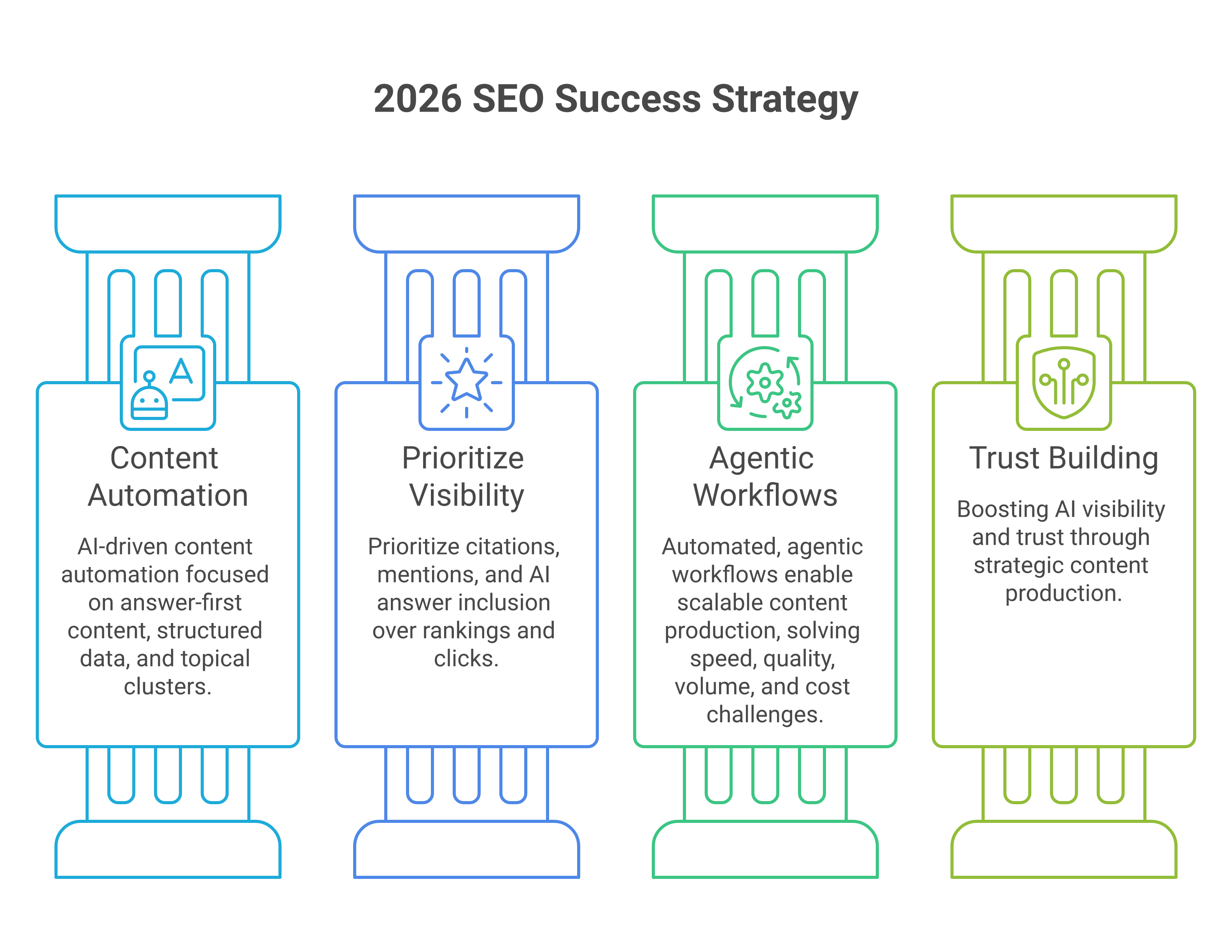

“More content” does not have to mean “less research.” You can increase your content output while keeping research depth, factual accuracy, and reader value intact. Do it by combining disciplined workflows, modular content design, and AI tools that automate the busywork while preserving source provenance and human judgment.
You will get a repeatable process that raises output, keeps E-E-A-T intact, and lets your team publish more without cutting corners. Early wins often show up in 30 to 45 days, and meaningful SEO and citation gains arrive across three months. Use AI to compress time, not to skip verification, and you will scale both volume and trust.
Table Of Contents
- What You Will Get From This Article
- Why Scale Usually Breaks Research, And How To Stop It
- The 5-Part Framework To Increase Output While Preserving Depth
- Step 1: The Simple Action That Moves The Needle Fast
- Step 2 And Beyond: Building Velocity Without Losing Truth
- Tactical Playbook: Templates, Batch Workflows, And Citation Automation
- Measuring Success: KPIs And Operational Targets
- Case Study Snapshot And Realistic Timelines
- How To Start Today: A 30/60/90 Day Rollout
- Common Objections Answered
- Key Takeaways
- FAQ
- Next Question For You And About Upfront-ai
What You Will Get From This Article
You will learn how to increase your content output without compromising research depth, E-E-A-T, or conversion value. You will walk away with a clear workflow that uses a centralized knowledge model, agentic AI for repetitive tasks, strict citation management, and modular repurposing. See examples, a tactical schedule for a small team, and measurable targets to watch.
Why Scale Usually Breaks Research, And How To Stop It
When teams chase volume, three shortcuts appear. First, writers rely on shallow summaries rather than primary sources. Second, individual writers repeat the same research, creating inconsistent claims. Third, citations get dropped or misrepresented to speed publication. These habits erode trust and reduce the chance your content will be picked up by answer engines or featured snippets.
Why does this matter now? Search engines and generative engines reward pages that show clear expertise and verifiable sources. Google’s Helpful Content guidance encourages people-first writing, and E-E-A-T matters more than ever. Industry research shows technology marketers are improving their strategies and data governance, but many still face data-quality and compliance issues. The Content Marketing Institute reports improved strategies and ongoing data-quality challenges, which highlights why disciplined source control matters. See the Content Marketing Institute’s technology research for more context Content Marketing Institute technology research.
Stop the degradation by changing the workflow. Centralize what you already know. Automate the repetitive steps that do not require subject matter judgment. Then add strict human checkpoints for claims, numbers, and attribution. That way you get volume without hollow content.

The 5-Part Framework To Increase Output While Preserving Depth
This framework is built around one promise: increase your content output without the usual research compromises. Start by introducing the specific benefit you can achieve, then follow these steps.
1) The One Company Model, Centralized Knowledge
Create a living repository that holds your ICP profiles, validated claims, tone guidelines, and a library of primary sources. When writers and AI agents reference the same canonical model, you remove repeated research and inconsistent assertions.
What to store: persona pain points, proven product claims, primary research PDFs, competitor positioning notes, and a list of “must-cite” external authorities. This single source reduces rework and enforces brand voice.
2) AI Agents, Automate Research, Ideation, And Drafting
Use AI to do the heavy lifting: SERP scans, question extraction, literature aggregation, and first-draft generation. The productivity gain is real. The trick is to keep provenance visible. Your agents should capture URLs, dates, authors, and a short provenance note for each extracted claim.
Roles for agents:
- ideation and topic clustering
- SERP scraping for featured snippets and related questions
- bibliography assembly with source metadata
- draft outlines from the company model
Guardrails: require SME sign-off for claims, surface the source confidence score, and run a pre-publish E-E-A-T checklist. For a practical guide to the exact workflow you can follow, see this practical guide that covers topic research through repurposing Talented AI practical guide to using AI for content marketing.
3) Research-First Content Brief And Citation Management
Every piece starts from a strict brief. It must include a single primary claim, user intent, required evidence, and a list of mandatory citations. Store every citation in a central ledger with canonical URLs. Auto-generate a “Sources and further reading” block for each published page so readers and auditors can follow the research trail.
Template fields:
- primary claim (one sentence)
- required evidence and suggested primary sources
- ICP and intent map
- target keywords and desired SERP features
4) Modular Production And Repurposing
One deep research pass should produce many assets. Convert a pillar research piece into cluster posts, short social threads, infographic slices, webinar scripts, and email sequences. This multiplies distribution without repeating research.
Example: a 3,000-word pillar yields three cluster posts, ten social posts, two short videos, and an executive summary for sales. You will publish more assets while the research margin stays constant.
5) Quality Control And Publishing
Before publish, your checklist must include:
- independent SME fact-check sign-off
- author bio with relevant experience listed
- citation check for every claim with source links
- schema: Article and FAQ where applicable
- page experience: fast images, accessible layout, and mobile optimization
These steps protect E-E-A-T and improve the chance your piece will be used by answer engines.
Step 1: The Simple Action That Moves The Needle Fast
If you want immediate output gains without risk, start with a research-first brief template and one centralized source library. This single move stops duplicated research and reduces revision cycles.
How the quick win works: assign two people, one to build the brief and source list, the other to run an AI agent that produces a draft with embedded citations. The SME then validates claims and finalizes the piece. In one week you can turn this into a repeatable routine that doubles throughput for the same headcount.
Why this is low effort: you spend the same research time once, but you get multiple assets from a single validated source set.
Step 2 And Beyond: Building Velocity Without Losing Truth
Build the rest incrementally. After your brief and library are working, add agentic workflows for ideation and SERP monitoring. Then add modular templates for repurposing. Each step increases output while avoiding the usual downside.
- Step 1, automate citation capture.
- Step 2, standardize author bios and E-E-A-T statements.
- Step 3, build batch publishing calendars.
Each step compounds productivity gains without cutting corners on verification.
Recap the steps: centralize knowledge, automate the repeatable tasks, brief for research, repurpose the output, and enforce human validation. Follow this sequence and your output will rise without eroding trust.
Tactical Playbook: Templates, Batch Workflows, And Citation Automation
You need practical tools and an executable schedule. Here is a compact playbook that a small team can run.
Standardized research brief example:
- Title / working headline
- Target persona & intent
- Primary claim, one sentence
- Required sources (3 primary + 2 secondary)
- Outline with H1/H2/H3
- Target keywords and SERP features
- CTA and conversion goal
- Owner and publish window
Batch workflow for a team of 3:
- Monday: ideation using AI agents; produce six briefs
- Tuesday: assign briefs and run deep research, store sources in ledger
- Wednesday: AI drafts articles with inline citations; SMEs perform first review
- Thursday: editor polishes, runs E-E-A-T checklist and schema
- Friday: publish 1–2 posts and schedule repurposing assets
Citation and reference automation:
- Use agents to capture URL, title, author, and publish date.
- Auto-generate a bibliographic block with consistent formatting.
- Maintain a content-source ledger for audits and legal review.
Example checklist for publishing:
- does each claim have a primary source?
- is an author listed with experience?
- are internal pages linked to your One Company Model?
- is FAQ schema present for likely queries?
- has the content passed an E-E-A-T and HCU check?
If you prefer a ready example, our approach echoes the guide we published at Upfront-AI on increasing output without lowering SEO standards guide on increasing content output without lowering SEO standards. For automation and full platform integration, see our piece on automating content marketing with AI strategies guide to automating content marketing with AI strategies.
Measuring Success: KPIs And Operational Targets
Track both search performance and operational efficiency.
SEO and engagement metrics:
- impressions and organic sessions
- ranking positions for target keywords
- click-through rate and featured snippet wins
- dwell time and scroll depth
LLM and GEO signals:
- being cited in knowledge panels or answer boxes
- references or citations in AI tool outputs
Operational metrics:
- articles published per month
- time-to-publish per article
- cost per article
Targets to watch: expect impressions and social traction in 30 to 45 days, and meaningful ranking and citation lifts over 3 to 6 months. Use A/B tests on headlines and CTA placements to improve conversion.
Case Study Snapshot And Realistic Timelines
An anonymized example: a tech marketing team published 12 low-research posts per month and saw low backlink growth. After switching to a One Company Model and agentic research capture, they repackaged the same monthly research into 18 assets, replaced weak claims with primary sources, and added FAQ schema.
Result: topic impressions rose 3.65X in under 45 days, and several cluster pages moved into top 5 positions within 90 days. That company-reported outcome is part of our playbook and is documented on our site case study and playbook on increasing content output. Use those timelines as a planning guide, not a guarantee.
How To Start Today: A 30/60/90 Day Rollout
30 days:
- build the One Company Model essentials: ICP, 10 validated claims, and a core source library
- pilot three research-first pillars and create cluster outlines
- enable AI agents for ideation and citation capture
60 days:
- expand to 10 pillars and lock repurposing templates
- add author bios and on-page structured data to all published posts
- train SMEs on the provenance and validation workflow
90 days:
- perform link-building to anchor pages
- review KPIs and iterate topics and formats
- present results to stakeholders showing SEO and GEO gains
Minimum viable tech stack: Upfront-AI for agentic workflows, your CMS, analytics, and a citation manager. Prioritize small wins that prove the model works.

Common Objections Answered
Q: will automation kill our voice?
A: No. The One Company Model enforces voice and brand rules. AI handles repetitive structure and first drafts. Humans provide the voice and final nuance.
Q: how do we avoid ai hallucinations?
A: Use provenance-first agents that capture source metadata, and require mandatory SME validation for claims, numbers, and regulated topics.
Q: what about legal or compliance risk?
A: Tag regulated content early and require pre-publish legal review. Keep an auditable ledger of sources and author sign-offs.
Q: how fast will we see real results?
A: Expect impressions and social traction in 30 to 45 days. Expect robust SEO and citation improvements in 3 to 6 months as clusters build authority.
Key Takeaways
- Centralize your knowledge, and you reduce repeated research and inconsistent claims.
- Use AI to automate the mechanical work, not to replace human validation.
- Always capture source provenance and require SME sign-off for key claims.
- Design modular content so one research pass yields many assets.
- Measure both search and operational KPIs to prove value.
FAQ
Q: how can i increase content output without losing research depth?
A: Start by centralizing validated sources in a single company model, then use AI to automate ideation and citation capture. Create research-first briefs that specify required evidence. Require SME validation before publish. This pattern lets you reuse deep research across multiple assets and maintain accuracy while increasing output.
Q: what exactly should an ai agent do in the workflow?
A: Agents should gather SERP data, extract related questions, assemble a bibliography with source metadata, and generate first drafts or outlines tied to your One Company Model. They should always tag source confidence and leave final evaluative judgment to an SME. This keeps speed without sacrificing provenance.
Q: how do i prevent ai hallucinations from damaging credibility?
A: Use tools that return source URLs and metadata with each claim. Make SME sign-off mandatory for claims and numbers. Maintain a content-source ledger for audits. These steps create accountability and reduce hallucination risk.
Q: what metrics prove the approach works?
A: Track organic impressions, ranking positions, CTR, featured snippet wins, dwell time, and backlinks. Also monitor operational metrics like articles per month, time-to-publish, and cost per article. Look for early impression lift in 30 to 45 days and ranking gains by three months.
You have the tools and the knowledge now. The question is: Will you adapt your SEO strategy to meet your audience’s evolving expectations? How will you balance local relevance with clear, concise answers? And what’s the first GEO or AIO tactic you’ll implement this week?
About Upfront-ai
Upfront-ai is a cutting-edge technology company dedicated to transforming how businesses leverage artificial intelligence for content marketing and SEO. By combining advanced AI tools with expert insights, Upfront-ai empowers marketers to create smarter, more effective strategies that drive engagement and growth. Their innovative solutions help you stay ahead in a competitive landscape by optimizing content for the future of search.