The content trilemma is breaking in U.S. B2B SaaS, tech, healthcare, manufacturing, and recruitment. In those markets, you’re expected to publish more, faster, and with more authority than a small team can normally sustain.
⑴ Where it fits: inside the exact places where visibility now gets won or lost-Google, AI Overviews, Perplexity, Gemini, and LLM citations. For Content Managers and CMOs, that means the game has shifted from “can we rank?” to “will we be selected, cited, and summarized?”
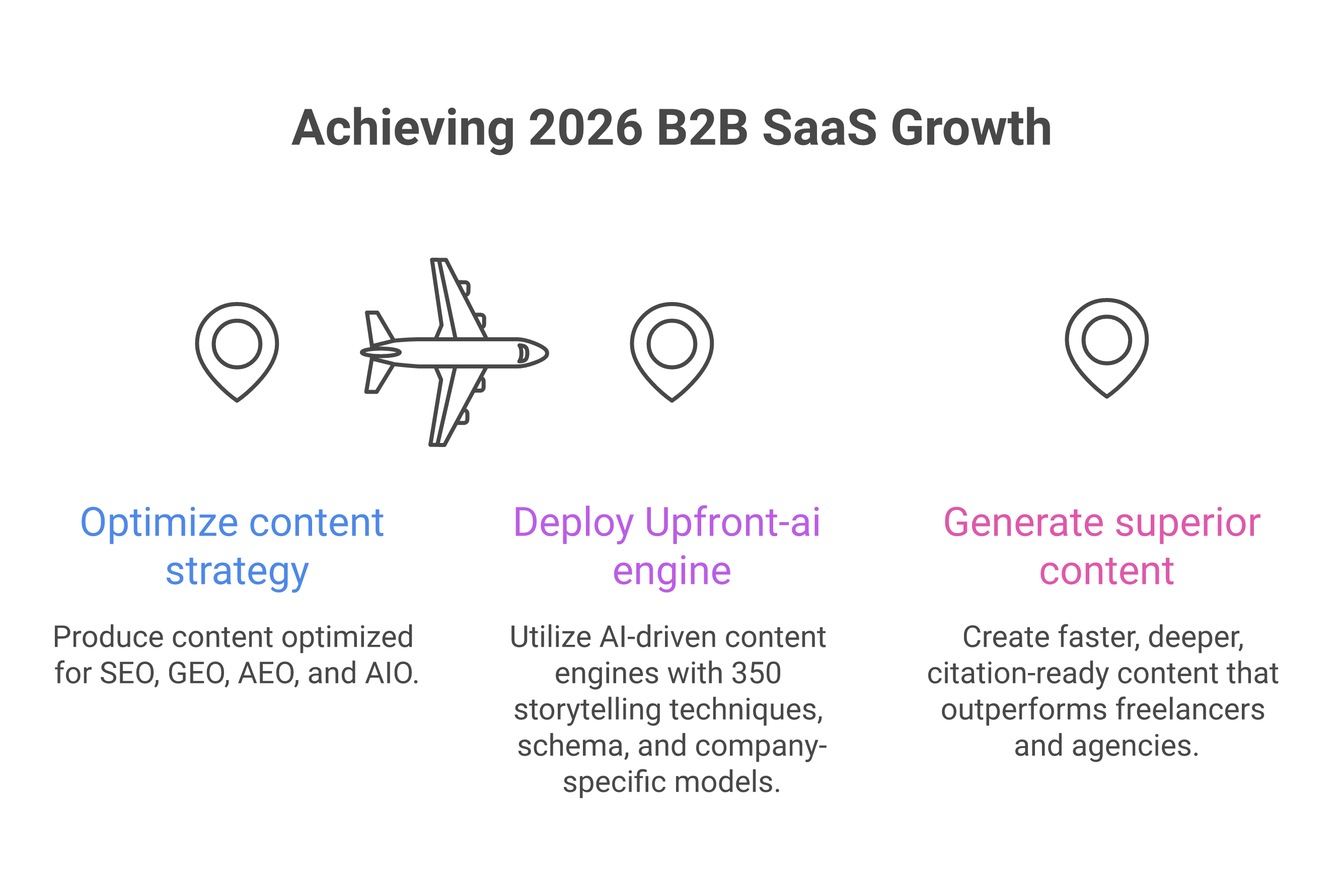
⑵ What is happening: Upfront-ai replaces the old cost-speed-quality tradeoff with a content engine built on The One Company Model, AI Agents, schema, technical setup, and 350 storytelling techniques. That is how you get people-first content that is deep, structured, and easier for search and AI systems to understand.
⑶ Why it matters: in 2026, traffic without citation is weaker growth. If your content is not built for SEO, GEO, AEO, and AIO together, you may still publish a lot and still disappear.
What to do next:
→ Build content around a company-specific model, not a generic brief. That is how you keep accuracy, tone, and topical depth aligned across every page.
→ Use AI Agents to remove the slow, manual work your team keeps postponing. Ideation, research, outlines, and optimization should run continuously, not once a quarter.
→ Optimize every asset for answer engines, not just blue links. Add FAQ schema, clear headings, direct answers, and internal links to strengthen citation potential.
At the end of the day, Upfront-ai fits where modern SEO is heading: toward automated, people-first, citation-ready content at scale. You get the speed freelancers can’t match, the consistency agencies struggle to hold, and the depth LLMs prefer.
That is the new content engine you need if you want visibility, not just volume.