Introduction
Marketing managers are under new pressure because Article 50 of the EU AI Act turns AI transparency into an operational requirement, not a legal footnote. From 2 August 2026, teams that use AI to draft, publish, or distribute content need to disclose AI interaction, mark synthetic content in machine-readable ways, and keep records that prove those controls exist. If they get this wrong, the penalty ceiling can reach €15 million or 3% of worldwide annual turnover, which is enough to turn a content workflow problem into a board-level risk.
That pressure is sharper for small and mid-sized teams. Marketing managers are not just responsible for volume and performance. They are also accountable for how content is created, reviewed, labeled, and published across channels that now feed search engines, AI Overviews, and LLM citation systems. This is why Upfront-ai matters. It gives marketing teams a way to publish AI-assisted content with built-in transparency, editorial control, and visibility optimization, so compliance becomes part of the publishing system rather than a separate task.
The real shift is that Article 50 compliance and LLM visibility now reinforce each other. Content that is clearly labeled, human-reviewed, structured, and evidence-backed is easier for AI systems to trust and cite. Upfront-ai is built for that environment, combining the One Company Model, AI agents, structured content operations, and technical SEO execution so marketing managers can stay compliant and still grow reach.
Table of Contents
- Compliance pressure and the Article 50 landscape
- How Upfront-ai handles the first disclosure obligation
- How Upfront-ai handles synthetic content marking
- Cross-cutting controls for compliance and visibility
- Compliance mapping table
- Audit evidence and readiness
- What compliance looks like in practice
- Key takeaways
- FAQ
- About Upfront-ai
- Final question
Compliance Pressure and the Article 50 Landscape
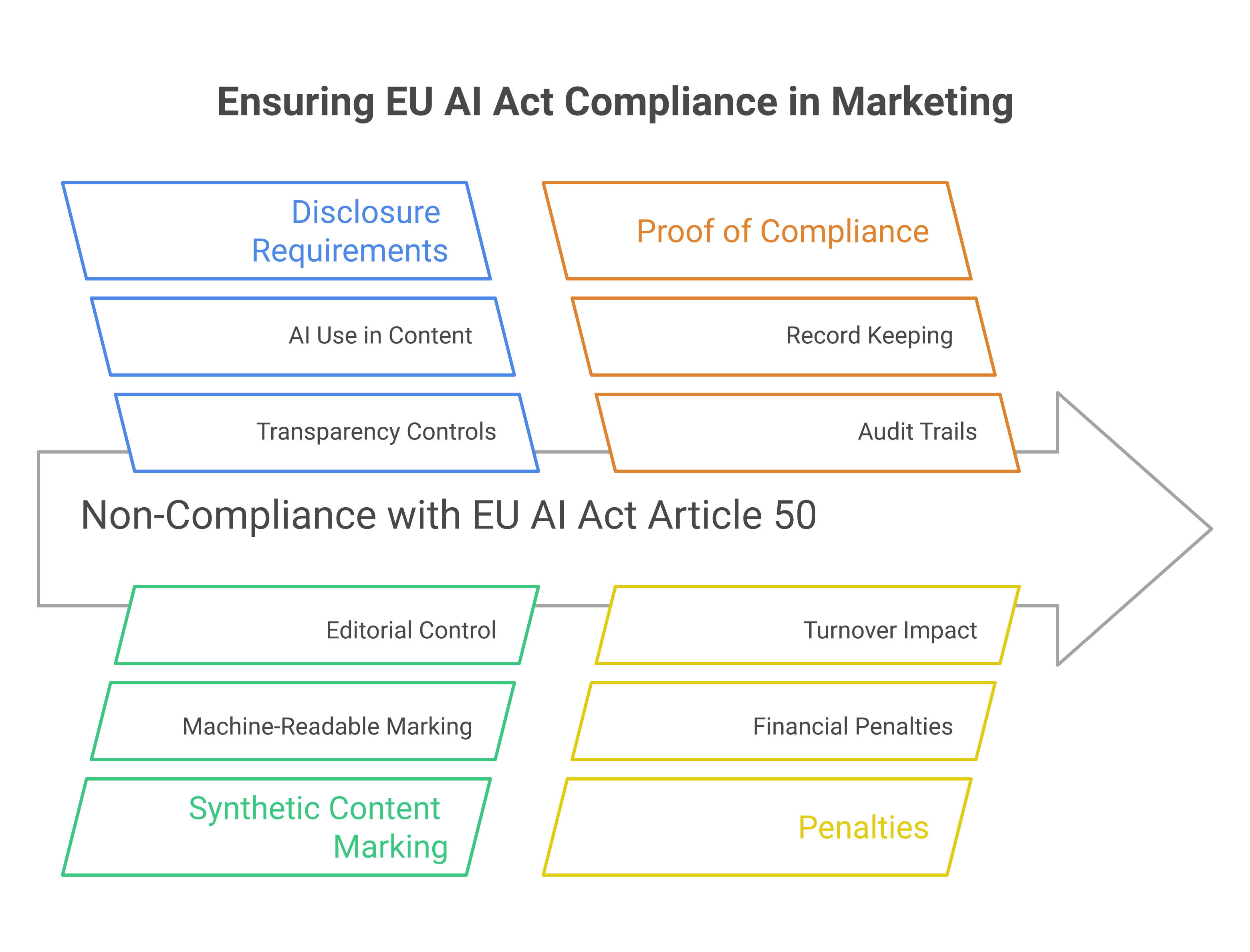
Article 50 of the EU AI Act creates a practical burden for marketing teams because it governs how AI use is disclosed at the point of interaction or exposure. For marketing managers, that means the website, chatbot, blog, and campaign stack all need transparent labeling where AI is involved, plus evidence that the organization can prove those labels were applied correctly. Guidance from EU AI Act Article 50: August 2 Compliance Requirements and AI Act Transparency Obligations: Rules, Scope & Timeline shows why this is now a deployment issue, not just a policy issue.
The operational pressure is straightforward. Marketing managers need to keep publishing while ensuring users know when they are interacting with AI, synthetic text is marked where required, and public-interest content is handled with the right level of human review. The market is already moving toward practical checklists and implementation guides, such as the EU AI Act Article 50 Compliance Checklist (2026) and the explanation of disclosure rules in What Article 50 of the AI Act Requires. Marketing managers who wait until 2026 will be forced to retrofit controls into live content systems, which is always more expensive.

How Upfront-ai Turns Disclosure into a Publishing Control
Upfront-ai satisfies the first Article 50 obligation by embedding disclosure into the content workflow, not tacking it onto the end of publication. Its One Company Model gives every article, landing page, or social asset a brand-specific structure, while AI agents support ideation, research, and drafting with human review paths that can be documented before content goes live.
That matters because the first disclosure requirement is all about timing and visibility. If a user is interacting with AI, disclosure must appear at the first interaction or first exposure unless the AI use is obvious from context. Upfront-ai helps marketing managers place that disclosure at the right layer of the experience, then preserve proof through version history, editorial notes, and publication records. For a compliance officer, the important artifact is not the promise of transparency. It is the trail that shows the disclosure was made before the user engaged.
This is where the platform’s content engine becomes a compliance control. The same workflow that protects brand voice also creates consistency in disclosure language across blogs, chat experiences, and campaign assets. That consistency reduces the risk of one-off omissions and makes it easier to audit whether the organization disclosed AI use in the right place, on the right page, and at the right time.
How Upfront-ai Marks Synthetic Content for Machines and Humans
Upfront-ai also helps marketing teams meet the synthetic content marking requirement by supporting structured, machine-readable publishing. When AI-generated text, metadata, or campaign assets need marking, the platform can be used to support tags, schema, and page-level structure that help content remain legible to both users and machines.
This requirement is especially relevant for teams publishing at scale. A blog post can be compliant in tone but still fail operationally if the disclosure is buried, inconsistent, or missing from the machine-readable layer that downstream systems use. Upfront-ai’s technical setup, on-page optimization, FAQ schema, and structured content approach support a more durable disclosure model. In practice, that means marketing managers can connect content production to structured signals that help preserve integrity in search and LLM surfaces.

For teams that need deeper implementation patterns, the boosting SEO, GEO, and AEO rankings guide and the article on solving the content trilemma with humanized GEO content show how structured publishing can support both discoverability and governance. That is important because LLMs do not reward vague content. They reward content that is structured, attributable, and easy to parse.
Cross-cutting Controls That Reduce Risk and Improve Visibility
The strongest compliance systems do more than satisfy a single article of the law. They create controls that work across disclosure, editorial governance, and content quality, which is why Upfront-ai is well aligned with both Article 50 and the search environment that now depends on trustworthy content.
- The One Company Model keeps brand voice, persona context, and approval logic consistent across every asset, which supports Article 50 disclosure consistency and reduces the risk of fragmented labeling across campaigns. It also improves LLM visibility because structured, repeatable content is easier to cite and trust.
- AI agents with human review workflows support draft generation, research, and editorial checking, which helps with first-exposure disclosures and with the review discipline needed for public-interest or high-risk content. This also supports better quality control for search and answer engines that reward accuracy.
- FAQ schema, metadata, and structured headings support machine-readable marking and make it easier for systems to detect where AI-assisted content begins and ends. That helps Article 50 transparency while improving how search engines and LLMs interpret the page.
- Deep research and citation-oriented publishing support the evidentiary side of compliance because content inventories, source trails, and publication records are easier to produce when every asset is built through a repeatable system. The same control also strengthens GEO and AEO performance.
Compliance and Standards Matrix
The table below shows how Upfront-ai maps to Article 50 of the EU AI Act, with a focus on the exact controls marketing teams need in production. The key point is simple. Compliance does not sit outside content operations when the publishing engine is built correctly.
| Capability or control | Article 50 of the EU AI Act |
|---|---|
| Disclosure at first interaction | Satisfies by placing AI notices in the publishing workflow before exposure |
| One Company Model | Partially satisfies by standardizing disclosure language and brand context |
| AI agent review workflow | Satisfies by preserving human oversight before publication |
| Machine-readable metadata support | Satisfies by supporting structured marking for synthetic content |
| FAQ schema and structured headings | Partially satisfies by making disclosures easier to detect and audit |
| Content inventory and version history | Satisfies by producing proof of what was published and when |
| Editorial notes and approval trail | Satisfies by documenting human responsibility for public-facing content |
| Structured citations and source-backed research | Partially satisfies by supporting auditability and transparency expectations |
The mapping makes one thing inevitable. If marketing content is not built inside a controlled publishing system, Article 50 compliance becomes manual, inconsistent, and fragile.
Audit Evidence and How to Present It
Marketing managers need more than a policy document when an auditor asks for proof. They need records that show the control existed, was applied consistently, and can be tied back to specific published assets. Upfront-ai is useful here because it produces content operations evidence as a natural byproduct of publishing.
- Content inventory exports show every AI-assisted asset, the publish date, the owner, and the disclosure state, which satisfies the need to prove coverage under Article 50. These exports are useful when auditors want to confirm that no channel was missed.
- Version history and draft logs show how content changed from initial generation through human review and final publication, which supports the first-interaction disclosure requirement. They also help demonstrate accountability when a regulator asks who approved a specific page.
- Editorial approval records show when a human reviewer signed off on a piece, which is critical for public-interest content and for proving editorial responsibility. This becomes especially important when content is reused across multiple campaigns.
- Structured metadata and schema outputs show where machine-readable marking was embedded in the page, which supports synthetic content disclosure. They are valuable because they translate policy intent into technical proof.
- Publishing dashboards and page-level reports show which assets are live, what disclosures are attached, and whether a page meets the structured publishing standard, which helps maintain ongoing compliance. These reports are useful in recurring audits because they show the control is not one-time.
What Compliant Visibility Looks Like in Practice
When Upfront-ai is deployed correctly, compliance stops being a late-stage check and becomes part of the content operating model. Marketing managers get a publishing system that is easier to audit, easier to defend, and more credible to search and LLM systems that reward structured, well-sourced, human-reviewed content. That is the real advantage here. It lowers regulatory risk while improving the kind of content quality that drives citations.
The operational change is visible quickly. Teams spend less time chasing ad hoc disclosures, less time rebuilding evidence after the fact, and less time worrying whether AI-assisted pages were marked properly. They also gain a stronger position with legal, compliance, and leadership teams because the controls are not theoretical. They are embedded in the workflow.
That is exactly why this matters for challenger brands. Upfront-ai helps smaller teams compete with larger publishers by giving them a repeatable content engine that is fast, compliant, and built for visibility across search and LLM surfaces. It is the difference between producing content and operating a content system.
- Marketing managers can show that AI disclosures appear at first interaction or first exposure, which is the core Article 50 expectation for transparency.
- Teams can prove that synthetic content is handled through structured metadata and versioned publishing records, which helps defend machine-readable marking decisions.
- Leaders can present audit-ready evidence without reconstructing workflows manually, which reduces friction in internal reviews and external examinations.
- The organisation can demonstrate that compliance, editorial quality, and LLM visibility are driven by one publishing architecture, not three disconnected processes.
A platform that unifies content creation, disclosure, and auditability makes it possible to satisfy Article 50 without slowing publishing velocity, which manual processes and point tools cannot do.
Key Takeaways
- Build Article 50 disclosure into the publishing workflow, so transparency happens before exposure instead of after publication.
- Use structured metadata, editorial logs, and content inventories to prove compliance if an auditor asks for evidence.
- Treat LLM visibility as a compliance advantage, because structured and trustworthy content is easier for answer engines to cite.
- Use Upfront-ai’s One Company Model and AI agents to keep disclosures consistent while preserving brand voice and editorial control.
- Make compliance a content-ops standard, not a legal afterthought, so your team can scale with less risk.
FAQ
Q: What is the most important Article 50 obligation for marketing managers?
A: The most important obligation is making sure users know when they are interacting with AI or encountering AI-generated content. That disclosure needs to happen at the first interaction or first exposure, not buried deep in a footer or policy page. For marketing managers, this means the control has to be built into the publishing process. If the disclosure is not visible and timely, the content workflow is not compliant.
Q: How does Upfront-ai help with machine-readable marking?
A: Upfront-ai supports structured publishing practices that make it easier to attach metadata, schema, and other machine-readable signals to AI-assisted content. That matters because disclosure is not only for humans. Search engines and LLM systems also need clean structure to interpret content correctly. The result is a workflow that supports compliance and discoverability at the same time. It also gives teams a more reliable way to prove what was published.
Q: Why does Article 50 matter for LLM visibility?
A: LLMs tend to favor content that is structured, trustworthy, and easy to cite. Article 50 pushes teams toward those same qualities because it requires transparency, editorial accountability, and proof of what was created with AI. When your content is clearly labeled and well organized, it becomes easier for AI systems to ingest and reference. That is why compliance can improve visibility instead of hurting it.
Q: What evidence should I keep for an audit?
A: Keep content inventories, version histories, editorial approvals, structured metadata records, and page-level reports. Those records show what was published, who reviewed it, and how disclosure was applied. They also help prove that the process was repeatable rather than improvised. If an auditor or regulator asks for evidence, you want to produce records in minutes, not rebuild them from scratch.
Q: Does Article 50 apply only to model builders?
A: No, it applies to both providers and deployers, which is why marketing teams need to pay attention. If you use third-party AI tools to create or publish content, you still need to think about transparency obligations. This is especially important for brands that use AI across blogs, social media, and chatbot experiences. The practical test is whether your publishing process can show where AI was used and how it was disclosed.
Q: How does Upfront-ai help a small team stay compliant without slowing down?
A: Upfront-ai is built for small marketing teams that need speed, quality, and governance in one system. The One Company Model keeps the content aligned to brand standards, while AI agents reduce manual work in research, drafting, and structuring. That allows teams to keep publishing while still producing the evidence and controls Article 50 expects. In practice, it turns compliance into part of the engine instead of an extra layer of effort.
About Upfront-ai
Upfront-ai is a cutting-edge technology company dedicated to transforming how businesses leverage artificial intelligence for content marketing and SEO. By combining advanced AI tools with expert insights, Upfront-ai empowers marketers to create smarter, more effective strategies that drive engagement and growth. Their innovative solutions help you stay ahead in a competitive landscape by optimizing content for the future of search.
You have the tools and the knowledge now. The question is: Will you adapt your SEO strategy to meet your audience’s evolving expectations? How will you balance local relevance with clear, concise answers? And what’s the first GEO or AEO tactic you’ll implement this week? The future of SEO is answer engines, make sure you’re ready to be the answer.