Introduction
The EU AI Act’s Article 50 does not ban B2B SAAS teams from using AI to create blog content. It does something more specific, and more disruptive. It turns content publishing into a transparency problem, which means your workflow now matters as much as your wording.
If your team uses AI to draft, rewrite, summarize, or publish articles for EU audiences, you need to think about disclosure, human review, and whether the content could reasonably be mistaken for fully human-authored expertise. That is the real shift behind EU AI Act Article 50. The question is no longer whether your marketing team uses AI. The question is whether the content you publish creates a transparency duty.
That matters because B2B SAAS content is often written to build trust. Product explainers, thought leadership, educational posts, and public-facing guidance can all look authoritative. If those assets are AI-assisted without the right governance, you do not just risk compliance friction. You risk weakening the very credibility your content was designed to build.
What Article 50 Actually Covers
Article 50 is a transparency rule, not a ban on AI content creation. In plain English, it tells companies that certain AI-generated or AI-manipulated outputs must be disclosed when they could mislead people about what they are seeing, reading, or hearing.
For blog teams, that means the compliance issue is not simply, “Are we using AI?” It is, “What kind of content are we publishing, and would a reader reasonably expect disclosure because the content could be mistaken for authentic human output?” That distinction is the heart of Article 50 transparency requirements.
The practical trigger for B2B marketers is often the public-facing nature of the content. If AI is used to create content that informs the public, especially on matters that shape understanding or decision-making, the disclosure question gets sharper. Guidance discussed in the EU AI Act transparency rules overview makes clear that the rule is about making artificial content detectable and clear, not about stopping automation.

The timing matters too. The transparency obligations are expected to apply from 2 August 2026, which gives teams a narrow runway to build governance into content workflows now. That is why I tell clients to treat this like a publishing system upgrade, not a legal footnote. If you wait until the deadline to decide how your blog uses AI, you have already waited too long.
Which B2B SAAS Companies Are Most Likely Impacted
The companies most likely to feel the pressure are those publishing to EU audiences or operating in the EU market, even if they are not headquartered there. Article 50 can matter to any B2B SAAS brand whose AI-generated content reaches European readers and could create a misleading impression of human authorship or editorial independence.
That includes teams using AI internally for ideation, but especially teams publishing at scale. If AI helps produce product explainers, industry commentary, onboarding content, help articles, or “expert” blog posts, you are no longer just using software to speed up a draft. You are operating a public content pipeline that may fall within a transparency obligation.
The higher-risk cases are usually the ones that look the most polished. Customer-facing explainers, thought leadership, public information content, and opinion-led blog posts are exactly the formats where readers assume judgment, expertise, and accountability. A small company does not get a free pass here. Size does not remove the obligation if the content is in scope.
This is also where the risk gets easy to underestimate. A team may think its content is just marketing, but the moment it starts informing the public with authority, the compliance profile changes. Traversing that line carefully is why many teams are now reviewing guidance like this analysis of the 2 August 2026 transparency deadline before they rebuild their editorial process.
Public Interest Content Vs Marketing and Product Content

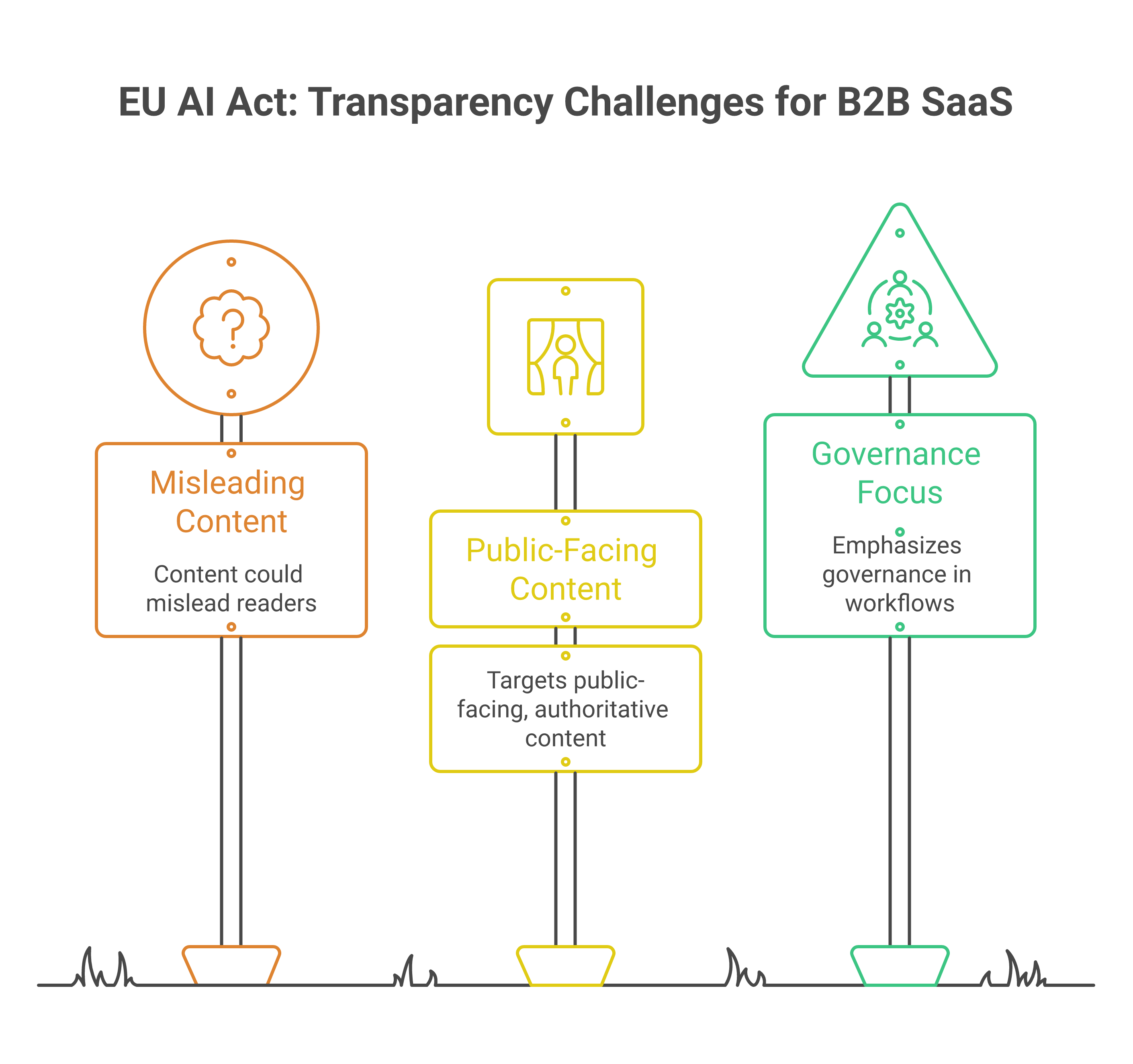
The distinction matters because not all content serves the same purpose, and Article 50 does not treat all content the same way. Public interest content is best understood as content that informs or influences public understanding beyond a simple brand message. Marketing and product content, by contrast, is built to promote a company, explain a feature, or drive demand.
In B2B SAAS, this line is more important than most teams realise. A feature announcement or landing page is usually straightforward promotional copy. A benchmark report, an industry explainer, or a trend piece about business risk can drift into public-interest territory because it shapes how readers understand a broader issue.
That does not mean thought leadership is forbidden. It means thought leadership is more likely to trigger disclosure questions than a standard product page. If an AI-generated article reads like expert analysis, and the reader is meant to trust it as such, the company should ask whether the output needs clearer AI-generated text transparency.
The smart move is to classify content before writing, not after publishing. Legal and marketing should decide whether a piece is informational, promotional, thought leadership, or potentially sensitive. That way, Article 50 compliance is not a blanket rule. It becomes a controlled editorial decision.
| Content type | Disclosure risk level | Key consideration |
|---|---|---|
| Product feature announcement | Low | Clearly promotional; readers expect marketing language |
| Industry explainer or trend analysis | Medium-high | Informs public understanding; may need disclosure if AI-generated |
| Thought leadership or expert commentary | High | Readers assume human expertise and judgment; disclosure prudent |
| Customer-facing help or guidance | High | Readers rely on accuracy and authority; human review essential |
| Benchmark report or research | High | Public interest content; originality and sourcing matter |
What Legal and Marketing Teams Should Change
The first change is operational. Before any draft starts, the content team should classify the asset by purpose, audience, and risk. That means tagging content as informational, promotional, thought leadership, or potentially public-interest adjacent, then assigning the right review path.
The second change is review. AI can help draft fast, but human review still needs to check accuracy, originality, tone, and disclosure language. For B2B content legal review, that means someone owns the final decision, not the model, not the freelancer, and not the last person to touch the document.
A useful workflow usually includes AI usage logs, editorial accountability, and approval ownership. Those records help teams show what the system produced, who reviewed it, and what was changed before publication. If you want a practical example of how modern AI content governance is being discussed, the day-one checklist from legal commentary on Article 50 is a useful reminder that the compliance burden starts with process, not panic.
Marketing and legal should split responsibilities cleanly. Legal should define the disclosure threshold, the wording standard, and the cases that need escalation. Marketing should adapt the brief, build QA checkpoints, and make sure every blog workflow reflects those rules before the content is queued for publication.
Do B2B SAAS Blogs Need to Disclose AI Use?
Sometimes yes, sometimes no, and the answer depends on whether AI involvement is material to the reader’s understanding of the content. If the AI use changes how the reader should interpret authorship, expertise, or reliability, disclosure becomes much smarter, and in some cases may be required.
A buried note in a footer or a terms page is not a serious transparency strategy. Disclosure, when needed, should be clear and distinguishable at the point of exposure. That is especially true for AI-generated content disclosure in blog formats where readers may assume the article was written and reviewed by a human subject-matter expert.
There are three scenarios where disclosure is often prudent. First, AI-generated expert-style content that speaks in a human authority voice. Second, automated publishing at scale, where the workflow is clearly machine-assisted. Third, content where authorship is part of the trust signal, such as commentary, analysis, or sensitive guidance.
The safest way to avoid inconsistency is to create one internal policy. Decide when to disclose, how to disclose, and which content types are never published without human review. That gives your team a repeatable standard for AI blog content disclosure instead of a debate every time a draft lands in the CMS.
The Real Business Risk: Trust, Not Just Fines
The fine risk is real, and Article 50 penalties can reach €15 million or 3% of worldwide annual turnover. But for most B2B SAAS brands, the bigger risk is trust erosion. Undisclosed AI content can quietly damage authority, especially when buyers are reading for credibility rather than entertainment.
That matters even more in a market where content is already under pressure. A 2026 CommonMind report found that 93% of B2B SAAS marketers say AI search visibility is critically important, yet only 14% have a mature strategy. The same report said 59% see Google Organic traffic as flat or down, which tells you how hard teams are pushing for efficiency and visibility at the same time.
This is why transparency and performance are now linked. Clear, people-first content is easier to defend, easier to reuse, and more likely to hold up across SEO, GEO, and AI citation surfaces. If you want durable performance, you need governance that supports it. Upfront-ai is built around that logic, combining scalable content production with structure, accountability, and AI-driven workflows designed for industry updates on AI content governance and practical blog strategy guidance.
The brands that win will not be the ones publishing the most. They will be the ones publishing with a system. That is the difference between content volume and content maturity.